The short answer comes down to what you are screwing on and how you shoot.
If you shoot landscapes from a tripod and primarily use effect filters—such as circular polarizers or dark diffusion—buying one large filter (typically 77mm or 82mm) and a couple of step-up rings is financially sensible. You buy one premium glass filter instead of three, and the slower pace of tripod work accommodates adapting rings.
However, if you are buying protective filters (UV or clear protection), shooting handheld with original bayonet hoods, or carrying compact fixed-lens cameras like the Leica Q3 43 or Fujifilm X100 series, step-up rings quickly create more problems than they solve. For daily shooting and lens protection, buying the exact filter thread diameter is the only setup that maintains your workflow.
When Step-Up Rings Actually Make Sense
The financial argument for step-up rings is straightforward. Quality optical glass with precision multicoating is not cheap. If you own three zoom lenses with front filter threads measuring 67mm, 72mm, and 82mm, outfitting each lens with its own top-tier circular polarizer or 1/4 black mist filter can easily set you back $250 to $400.
By purchasing an 82mm filter and two step-up rings (67mm-to-82mm and 72mm-to-82mm), you spend once on the glass and under $30 on the brass or aluminum rings.
This setup works well under specific conditions:
- Tripod landscape photography: When your camera is locked on a tripod, taking an extra thirty seconds to thread a step-up ring and position your polarizer does not cost you a shot.
- Controlled video rigs: When using variable NDs or mist filters on cinema rigs where matte boxes or large front diameters are standard.
- Infrequent filter use: If you only pull out a polarizer twice a year for autumn foliage, owning multiple dedicated sizes rarely justifies the cost.
If your shooting fits that profile, step-up rings deliver undeniable value. But photographers often attempt to apply this same cost-saving logic to their entire lens kit, only to encounter three physical limitations in the field.
The Three Hidden Penalties of Step-Up Rings in the Field
Adapting a larger filter onto a smaller lens barrel sounds harmless on paper. In practice, altering the physical geometry of your lens front introduces mechanical compromises.
1. You Lose Your Original Bayonet Lens Hood
Almost every modern prime and zoom lens features an outer bayonet mount engineered specifically for its dedicated plastic or metal lens hood. The moment you screw on a step-up ring that flares out from 58mm or 67mm to 82mm, the outer diameter expands well beyond the hood's bayonet tracks.
Your original lens hood can no longer slide over the barrel or click into place.
Losing your hood is not merely an aesthetic compromise. A deep lens hood serves two critical functions:
- Shading oblique light: It cuts off off-axis sunlight that causes low-contrast flaring and internal barrel ghosting.
- Mechanical buffer: When carrying your camera on a shoulder strap or moving through crowded streets, the hood absorbs knocks against doorframes, tabletops, and guardrails.
Without it, your newly adapted $120 filter sits exposed on the leading edge of your camera, vulnerable to side impacts. For photographers who depend on original hoods, keeping a slim filter in the native thread is non-negotiable. We explored this mechanical trade-off in detail in our breakdown on screw-in vs magnetic filters and original hoods.
2. Wide-Angle Vignetting from Stacked Ring Depth
A single, well-machined step-up ring adds only a few millimeters of forward protrusion. But photographers frequently jump multiple sizes by stacking rings—such as taking a 52mm prime to 58mm, and then 58mm to 77mm.
Stacking rings creates a physical metal tunnel projecting forward from the front element. On telephoto or normal focal lengths (50mm and longer), this rarely causes an issue because the angle of view is narrow.
On wide-angle lenses (anything wider than 28mm on full frame, or 18mm on APS-C), the lens captures an expansive field of view. The forward lip of stacked step rings will visibly cut into the corners of your frame, producing hard, mechanical vignetting. Unlike optical light falloff, mechanical vignetting represents complete obstruction of light; software lens profile corrections in Lightroom cannot recover those blackened corners.
To avoid dark corners when shooting wide, optical elements must sit as close to the front barrel as possible, which requires a dedicated slim filter in the native thread. See our analysis on slim vs regular filter vignetting and hood clearance for the optical clearance thresholds.
3. Thread Binding and Field Friction
Inexpensive step-up rings are stamped from soft aluminum. When you thread an aluminum step ring into an aluminum filter thread, temperature changes between dawn and afternoon can cause the metals to expand unevenly.
If you overtighten the ring while rotating a circular polarizer, the threads can experience galling—microscopic metal friction that locks the two rings together. Trying to separate an overtightened 82mm filter from a 67mm step-up ring with cold hands while the light is fading is an exercise in frustration.
Compact Cameras: Why Lens Adapters Are Not Step-Up Rings
A frequent point of confusion among street and travel photographers involves fixed-lens compact cameras like the Fujifilm X100 series (X100VI, X100V) and the Leica Q series (Leica Q3, Q3 43).
A step-up ring changes thread diameter from small to large (for example, 49mm to 67mm). An adapter ring on a camera like the Fujifilm X100 is an entirely different mechanism.
Out of the box, the Fujifilm X100 has no exposed male filter thread. Its front element moves forward and backward during close-range focusing. If you attempted to screw a filter directly onto the inner thread without an adapter, the moving lens barrel would collide with the back of the filter glass, triggering a camera focus error.
To use filters on an X100, you must remove the front decorative ring and attach a dedicated adapter ring (such as the AR-X100), which acts as a protective barrel spacer and exposes a standard 49mm female thread. We documented this exact mechanism in our guide on Fujifilm X100 49mm filter threads and adapter rings.
Similarly, the Leica Q3 43 features a native 49mm filter thread (despite the "43" in its focal length name, as explained in our Leica Q3 43 filter sizing breakdown).
Putting a step-up ring on an X100 or a Leica Q3 defeats the entire purpose of owning a compact rangefinder-style camera:
- It blocks the optical viewfinder (OVF) window on hybrid viewfinders.
- It throws off the camera's front-to-back balance on a wrist strap.
- It prevents the camera from sliding into a small jacket pocket or everyday sling bag.
For compact prime systems, always mount the exact 49mm filter directly to the adapter or lens barrel.
Protection Filters Always Belong on the Native Thread
While you can debate whether to step up a circular polarizer or an ND filter, lens protection filters (UV and Clear) should always be bought in the exact thread diameter.
A protective filter is designed to be installed once and remain on the lens permanently. It lives in your bag, endures daily bumps, and stays attached whether you are shooting street scenes or packing your kit into overhead luggage.
You cannot leave an 82mm filter on an 82mm step-up ring permanently attached to a 58mm prime lens. The camera will not sit flat in your bag, the original snap-on lens cap will not fit, and your lens hood is rendered useless.
Before buying, double-check the filter size printed on your lens barrel or front bezel—look for the diameter symbol (ø), such as ø49, ø58, ø67, or ø77. If you are unsure where to look, consult our walkthrough on how to read the filter size printed on your lens.
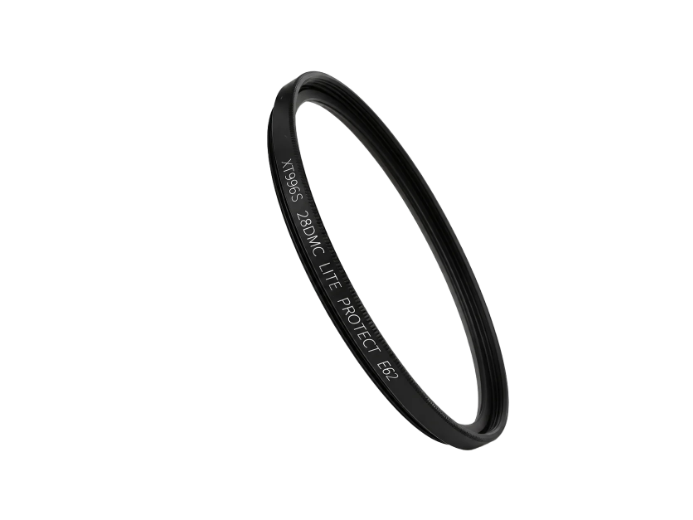
If you are looking for everyday protection that preserves full lens hood compatibility and maintains pocketability, our XT996 PRO Black Frame Lens Protection Filter is engineered with an ultra-slim aluminum ring that seats cleanly beneath original bayonet hoods. Built with dual-sided 36–48 layer multicoatings, it delivers ≈99.6% light transmission with an exceptionally low average reflectance of ≈0.08%, protecting your front element from scratches and dust without introducing ghosting or softening fine detail.
The Decision Checklist for Your Kit
When planning your filter kit, use this quick checklist:
| Shooting Scenario |
Recommended Route |
Practical Reason |
| Everyday Protection (UV / Clear) |
Exact native size |
Stays on the lens full-time; fits original lens hoods and caps. |
| Street & Travel (X100, Q3, compact primes) |
Exact native size |
Preserves compact ergonomics, weight balance, and pocket fit. |
| Handheld Fast-Paced Shooting |
Exact native size |
Retains bayonet hood protection against bumps and stray flare. |
| Tripod Landscape Work (CPL, Mist) |
One 77mm or 82mm + Step-Up Rings |
Workflow is deliberate; saves hundreds of dollars across multiple zooms. |
| Wide-Angle Lenses (Wider than 24mm) |
Exact native size (Slim frame) |
Avoids hard corner vignetting caused by forward ring projection. |
Still Wondering What Makes Sense for Your Bag?
Every photographer's lens combination is different. If you have two zooms and three primes and are debating between a single adapted filter kit or dedicated sizes, send an email to info@xtfilters.com. Tell us your camera body and the exact focal lengths in your bag, and we will tell you honestly whether step-up rings will work cleanly or cause hood and vignetting headaches.
All orders over $99 ship with free standard delivery ($8 shipping for orders under $99). Every XT Filters purchase is backed by our 30-day return policy and a 12-month warranty, with secure checkout supported via Stripe (all major credit and debit cards) and PayPal.