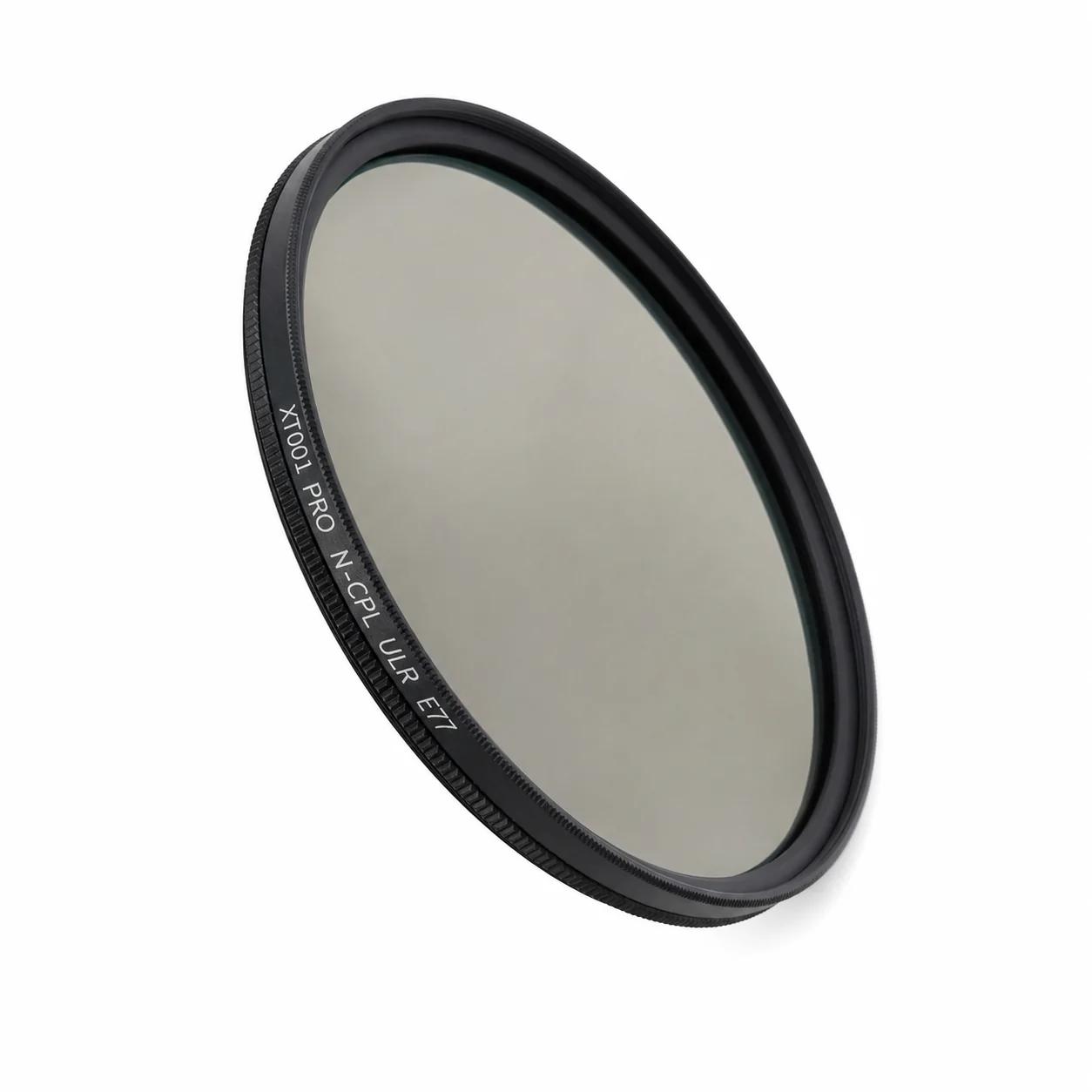
The filter is fine. Put a 16–35 on the camera, point it at a clear sky, turn the polarizer to full strength, and one side of the frame will go deep blue while the other stays pale. That step between them is in the sky, not in the glass. A polarizer can cut one band of skylight; it cannot put the whole frame at the same angle to the sun, and a wide lens is the thing that drags both ends of that band into the same picture.
One band of sky is polarized. The rest is less so.
Sunlight scattered by the atmosphere comes to the lens partly polarized, and the polarization is strongest about 90° away from the sun. Turn a CPL until it blocks that orientation and the sky at roughly 90° goes dark blue. Sky close to the sun and sky near the horizon are polarized less, so they barely change.
Now the lens. A 100mm sees a narrow slice of the world — call it 20° across — and every part of that frame is at nearly the same angle to the sun, so the darkening lands evenly over the whole image. A 14mm covers well over 100° corner to corner. One side of the frame can be 60° off the sun and the other side 140°. The band of maximum darkening has to fall somewhere inside the picture, and it will not be gentle.
Go wider still and the band can cross the frame twice, leaving dark, lighter, dark. That is the "X" or hourglass people post about. Same geometry, no separate fault.
Turning the ring does not fix it. Rotation only decides how much of the band you cut: all the way is the deepest gradient and the strongest glare removal, halfway is a milder gradient and less of the glare. The shape stays because the angles stay.
Three minutes to tell physics from a bad filter
A filter that arrived with a warped polarizing film, or one that has delaminated, looks different from this, and it is worth knowing which problem you have before you send anything back.
Uneven sky that shades smoothly in one direction, with an edge you can follow across the frame, is geometry. Nothing to fix.
Corners dark on all four sides at once, worse wide open and better at f/8, is usually something sitting in front of the front element: two filters stacked, a thick ring on a wide lens, a hood that reaches too far. Take the stack apart and shoot one frame before you blame the glass.
Blotchy or streaky darkening, uneven in a way that does not match the sky, changing as you rotate but never forming a clean gradient, is a film problem rather than a light problem. That one is a defect, and a defective filter is the return case, not the wide-angle case.
The quick confirmation: face a flat, evenly lit wall, focus past it, and rotate. A good CPL darkens the wall evenly from edge to edge. A bad one leaves patches.
What a CPL still does on a wide lens
Plenty — just not skies.
Reflections off water, glass, wet stone and varnished leaves are polarized at the surface itself, and where that surface is even the cut is even, at any focal length. A 16mm over a harbour at midday still strips the glare and lets the water show its own colour; the sky above it is simply not the part you bought the filter for. That job is covered in more detail in how a polarizer turns white water clear, and the same reasoning runs through polarizers for autumn foliage.
So the wide-lens rule is about the subject, not the lens. Water, glass, foliage, anything with a reflective surface filling the frame: keep it on. A sheet of blue sky as the main event: it will band, and no amount of turning will save it.
When I take it off
An ultra-wide pointed at open sky is the one case where I leave the polarizer in the bag. Between roughly 14 and 24mm on full frame, the gradient is stronger than anything I can fix by composition, and it looks like a mistake in the file even when the scene was beautiful.
At 28mm it depends on where the 90° band sits. Keep it out of the frame — sun behind me, or the band off the top edge — and a 28mm can be fine. Point the wide side of the frame into the band and it will show.
If I want an even deep sky on a wide composition, I use a longer lens and stitch: four or five frames at 50mm, each one narrow enough to sit inside a single band, then merge. It is slower, and it is the cleanest way to get that look without painting it in afterwards. Some days the honest answer is to take the filter off and let the sky be the colour it is.
One more thing that catches people on wide lenses: a CPL in front of a UV filter is two rings deep, and the corners feel it before the sky does. If you are stacking on anything wider than about 28mm, that is a different problem with its own cause — ring thickness in front of a wide front element, covered in slim versus regular filters.
What we make
The XT001 PRO CPL is our flagship circular polarizer, 43–95mm across thirteen sizes. Nitto polarizing film, so the polarization itself is consistent across the disc rather than strongest in the middle. B270 glass underneath, which gives the coating a stable base to sit on. Average reflectance is ≈0.1%, which is the number that matters at night: a street lamp in front of the lens does not throw a second image back at the sensor. Coatings run 36–48 layers on both surfaces, so both faces are managed, not just the one you can see.
That ≈0.1% is also why the filter is not the variable in an uneven sky. A coated surface this flat reflects almost nothing, which means whatever gradient you see in the frame came from the light.
For skies past 50mm and for water at any focal length, this is the filter I would put on. For a 14mm looking at a blue sky, save the money and take it off. If you are working out whether the flagship is worth it over the budget CPL, that comparison is here; the decision changes with how often you shoot into reflective surfaces, not with how much you paid for the lens.
Order the millimetre printed next to the ø on the front ring — here is how to find it — because the thread decides, not the focal length.
Any filter can come back within 30 days — no restocking fee. Every XT filter also carries a 12-month warranty against manufacturing defects. Orders over $99 ship free; under that, standard shipping is $8.
— Leo Liang