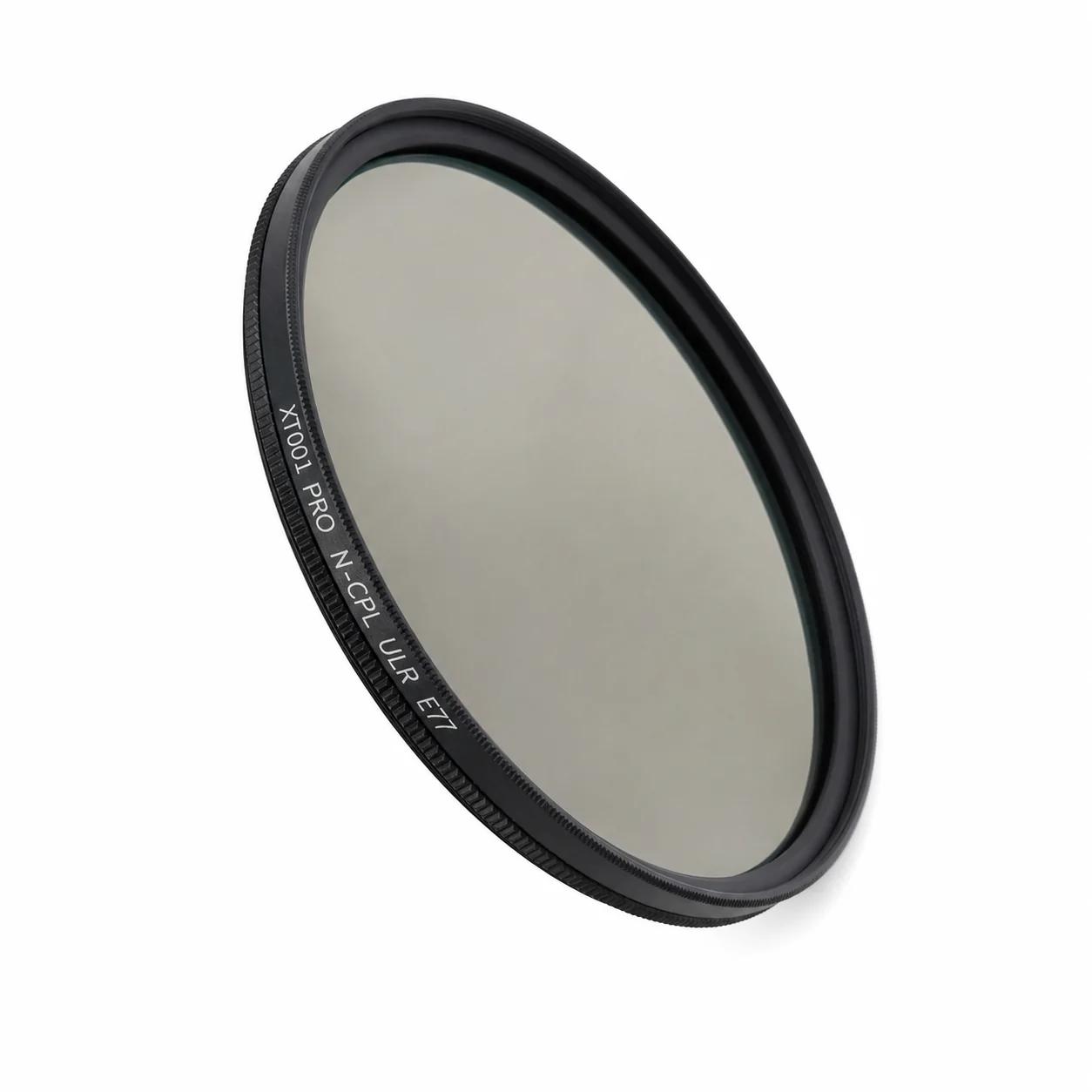
Ask any experienced landscape photographer which filter stays permanently in their bag, and the answer is almost always a Circular Polarizer (CPL).
Digital sensors and editing software have made neutral density gradients and color tint filters largely obsolete. But glare is a physical phenomenon. When sunlight strikes non-metallic surfaces—water surfaces, wet river rocks, glossy foliage, or damp mountain slopes—it reflects as polarized light waves. Once your camera sensor records that specular glare as blown white pixels, no slider in Lightroom can bring back the hidden textures underneath; lowering highlights simply turns harsh white reflections into dull, muddy gray.
A physical CPL strips away that surface reflection before light ever touches your sensor. But when you browse polarizing filters today, the price range is enormous: budget options sit under $40, while premium flagship filters easily climb past $80. What actually changes between a budget CPL and a flagship model, and which one belongs on your landscape kit?
What a CPL does (and what post-processing cannot fake)
Light traveling directly from the sun vibrates in all directions perpendicular to its path. When that light bounces off reflective surfaces like a mountain lake or wet autumn leaves, the reflected rays become linearly polarized, vibrating primarily in a single plane.
A circular polarizing filter contains two bonded optical layers: a linear polarizing film sandwiched between protective glass, followed by a quarter-wave retardation plate. When you rotate the outer ring on your lens, you align the polarizing film perpendicular to the reflected light waves:
- Cutting water and wet rock glare: At an angle of roughly 30° to 35° relative to the surface (Brewster’s angle), rotating the filter cuts surface reflections almost entirely. Instead of a blinding white sheet of bounced sunlight, alpine streams reveal underwater gravel, lakebeds show submerged moss, and coastal tide pools turn completely transparent.
- Restoring saturated foliage: Wet leaves act like millions of tiny mirrors reflecting sky glare, making entire forests look washed out and hazy. Rotating a CPL cuts the sheen off wet foliage, restoring deep natural greens, golds, and reds straight out of camera.
- Deepening blue skies and atmospheric contrast: Polarizing effect peaks at a 90-degree angle from the sun. Rotating the ring filters out atmospheric Rayleigh scattering, dramatically increasing the separation between puffy white clouds and deep blue sky.
- Built-in light reduction for moving water: Because polarizing film naturally absorbs light, mounting a CPL reduces your exposure by roughly 1 to 1.5 stops. When you are photographing waterfalls or shoreline waves and want soft water movement, that 1-stop drop lets you stop down comfortably into f/8–f/16 at ISO 100–400 without immediately reaching for a separate neutral density filter.
The problem with bargain polarizers
Not all polarizing filters behave the same way in the field. Cheap, unbranded polarizers cut manufacturing costs in three critical areas:
- Substandard polarizing film: Low-cost polarizing sheets often introduce strong greenish-yellow or magenta color casts across the frame. Correcting an uneven color shift across a landscape photo in post-production is a frustrating headache.
- Poor optical parallelism: When the glass elements housing the polarizing film are not ground and polished to tight optical parallelism, the filter acts like a weak, uneven lens element. While your images might look passably sharp on a wide-angle lens at 24mm, zooming to 70mm or 150mm reveals smudged edges and softened fine details.
- Single-layer or missing anti-reflective coatings: Landscape photography frequently places the sun near the edge of the frame. Cheap glass with minimal coating creates violent internal ghosting, flaring, and lowered contrast across dark foregrounds.
To solve this, XT Filters builds both its budget and flagship lines around authentic Japanese Nitto polarizing film. That guarantees neutral color balance and a verified 99.8% polarizing efficiency across both tiers. The practical differences between our budget XT003 and flagship XT001 PRO come down to glass selection, coating density, and reflection suppression.
The everyday workhorse: XT003 CPL
If you want a dependable circular polarizer for weekend hiking, travel, and standard landscape shooting, the XT003 is engineered to deliver reliable optical performance without paying flagship premiums.
- Glass construction: Optical white glass (超白玻璃).
- Polarizing core: Genuine Nitto polarizing film with 99.8% polarizing efficiency.
- Coating: Double-sided 24–32 layer multi-coating.
- Optical specs: Average light transmission of ≈44% (providing roughly 1.2 stops of light reduction), with average reflectance held to ≈0.3%.
- Mount & sizes: Ultra-slim knurled black frame available from 39mm up to 82mm.
On standard zoom lenses like a 24–70mm or 24–105mm, the XT003 handles water reflections and foliage glare cleanly. The ≈0.3% reflectance and multi-layer coating keep contrast firm, and the neutral Nitto film means greens, river stones, and sky tones stay faithful to what your eyes saw.
The flagship landscape standard: XT001 PRO CPL
When you shoot on high-resolution camera bodies (40 megapixels and above), regularly use telephoto landscape lenses (70–200mm or longer), or frequently frame backlit sunrise and sunset scenes, the XT001 PRO provides the extra optical precision demanding scenes require.
- Glass construction: German Schott B270 optical glass.
- Polarizing core: Japanese Nitto polarizing film.
- Coating: Double-sided 36–48 layer multi-coating.
- Optical specs: Ultra-low average reflectance of ≈0.1%.
- Mount & sizes: Precision slim frame available from 43mm up to 95mm.
The upgrade to B270 optical glass and 36–48 coating layers addresses two specific field demands:
1. Optical parallelism across high-resolution sensors and telephoto zooms
Schott B270 glass undergoes precision double-sided grinding and polishing to ensure optical parallelism. High-resolution sensors and long telephoto focal lengths magnify microscopic glass imperfections. With B270 glass, your lens maintains edge-to-edge micro-contrast and fine detail whether you are shooting a wide valley at 28mm or picking out distant mountain ridges at 200mm.
2. Extreme flare and ghosting suppression near low-angle light
Sunrise and sunset light angles hit your front element obliquely. The XT001 PRO drops average reflectance to an ultra-low ≈0.1%. By preventing light from bouncing between the rear surface of the filter and the front element of your lens, shadow contrast stays crisp and veiling glare is held to an absolute minimum.
Field tips for getting the most from your CPL
- Watch out for the ultra-wide sky band: On focal lengths wider than 24mm (full-frame equivalent), your camera captures a field of view exceeding 84 degrees. Because the polarizing effect only peaks at exactly 90 degrees from the sun, the sky will show a dark blue band in the middle that fades out toward the edges. This is an unavoidable law of physics, not a filter flaw. When shooting ultra-wide, rotate the filter to a partial setting, or prioritize water and rock reflection removal rather than maximum sky darkening.
- Check Brewster’s angle on water: Polarizers are most effective on water when your camera aims downward at roughly 30° to 35° relative to the surface. If you are standing directly over water looking straight down (90°), or shooting nearly flat across a calm lake at water level, the polarizing effect is physically reduced. Adjusting your tripod height by a foot or two can dramatically increase reflection removal.
- Check your lens thread size before ordering: Look at the front barrel of your lens or the inside of your lens cap for the diameter symbol (ø). Common landscape thread sizes include 67mm, 72mm, 77mm, and 82mm.
Which CPL should you choose?
- Choose the XT003 CPL Circular Polarizer Filter if you need a high-efficiency everyday polarizer for hiking, travel, and standard landscape focal lengths. It provides true Nitto 99.8% polarization and optical white glass at an accessible price point.
- Choose the XT001 PRO CPL Circular Polarizer Filter if you shoot on 40MP+ sensors, frequently use telephoto zooms, or photograph harsh backlit sunrises and coastlines where B270 glass and ≈0.1% reflectance protect every ounce of sharpness and contrast.
Explore our complete CPL Polarizers Collection to find the exact thread size for your lens. All orders ship directly with free worldwide shipping on orders over $99 USD.
— Leo Liang