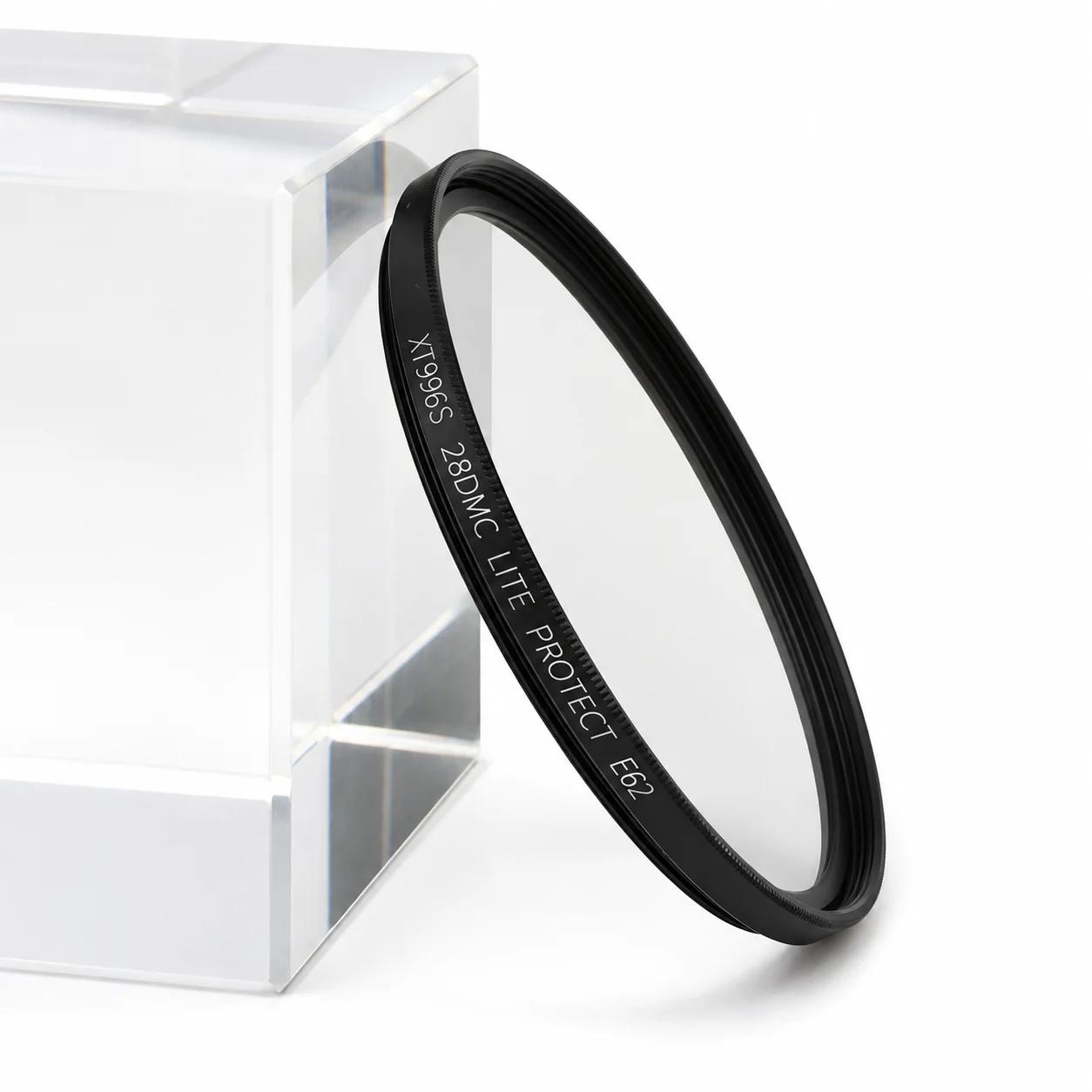
A filter is one of the few sub-$100 gifts that a photographer will actually keep using, and it still goes wrong for the same reason every year: the wrong size. Before you pick between a protector, a polarizer or a mist filter, find the thread size of the lens they shoot most. It is the one number that decides whether the gift screws on or goes back in the box.
The size is printed on the front of the lens, usually as a diameter mark followed by two digits: 49, 52, 58, 67, 72, 77, 82. It also shows on most lens caps and on the rim around the front glass. If you cannot get near the gear, look up the exact lens model online — every lens has one native filter thread, and it does not change between copies.
We keep a lens filter finder that takes a lens and returns the size, if typing "Nikon Z 24-70 f/2.8 filter size" into a search bar feels like too much homework on a gift.
Once the size is right, the gift question is really about what they shoot. Three paths cover almost everyone, and all three land under $100.
Everyday protection is the safest gift
If you are not sure what they want, give them a clear protector. It is the least opinionated filter there is: it does not change exposure or color, it just stands between the front element and the world — bag zips, fingerprints, sea spray, the day the cap stays in the pocket.
The XT996S Lens Protection Filter runs $44.99–79.99 depending on size, in 39–82mm. Its numbers are the boring kind that matter here: average transmission ≈99.6%, average reflectance ≤0.25%, and a double-sided 28-layer multi-coating. In plain terms, the frame looks the same with it on and the bright bits stop bouncing around as much as they would off a bare, weaker ring. It suits almost any lens, including the ones that cost more than the camera.
There is also a size-guide trap worth knowing if the lens is a fixed-lens compact like a Leica Q3 or a Fuji X100 — those have their own quirks, which we covered in how to read the filter size on your lens.
For landscape shooters: a polarizer
If they chase skies, water, wet streets or anything behind glass, a circular polarizer earns its keep. Turn the ring and reflections drop, skies deepen, and foliage separates. It is also the filter people most often buy badly, because the cheap ones cost too much light and the expensive ones are wasted on a first-timer.
The XT003 CPL is the value pick at $39.99–69.99 (39–82mm, black frame). It uses a Nitto polarizing film with a stated polarization efficiency of 99.8%, ultra-clear glass, and a double-sided 24–32 layer coating. Average transmission is around 44% — that sounds alarming until you remember a polarizer is doing real optical work, so it eats roughly a stop of light by design. That is normal, not a defect; you just shoot a little slower or raise ISO.
One caution: a CPL is the wrong gift for someone who mostly shoots people indoors. It can look flat on skin and there is rarely a reflection worth killing.
For portraits and evening work: Black Mist 1/4
If their work is portraits, street after dark, or any frame where the digital edge feels too sharp, the gift is a black mist filter — and the strength is 1/4. Not 1/8, which barely shows; not 1/2, which smears highlights the moment a light source is in frame. A quarter is the strength you can leave on all day.
The XT888 135 Bottom Black Mist 1/4 is $49.99–119.99 in 39–105mm. Average transmission is ≈88.8% and average reflectance ≈0.3%, with a double-sided 28–36 layer coating. It lifts the glow around highlights and takes the hard bite off skin while the eyes and detail stay where they are. It is built for focal lengths of 135mm and under, which covers the portrait and everyday glass most people own.
We keep this strength only in 1/4, so there is no confusing ladder to choose from.
The add-on that always fits: a cleaning cloth
Filters get fingerprints, and a photographer never has a clean cloth when they need one. The Nano Cleaning Cloth is the gift that needs no size at all — $10–20 for a 5, 15, 25 or 40 pack, ultra-fine microfiber that will not scratch a coating. It is the natural thing to throw in the same box as a filter.
It also solves a small logistics problem: standard shipping is $8, and we waive it on orders over $99. A $45 protector plus a cloth pack or two usually clears that line on its own.
What not to buy
Skip the filter entirely if you cannot confirm the thread size — a gift that will not mount is worse than a gift card. Skip a polarizer for someone who shoots only people. And skip any "one filter fits all lenses" bundle: threads are not universal, and adapters add vignetting on wide lenses.
If you are not sure, email us with the lens model and what they like to shoot, and we will point you at one size and one filter instead of a guess.
Shop what fits: the XT996S protector, the XT003 CPL, the XT888 Bottom 1/4 mist, or the cleaning cloth. If the size is still a mystery, start with the lens filter finder.
— Leo Liang