The Canon RF 24-105mm f/4L IS USM takes a 77mm screw-in filter. You will see it printed on the front of the barrel next to the ø mark, and Canon lists 77mm as the filter size on the official RF 24-105mm f/4L IS USM specification page. If the number stamped on your lens is not 77mm, you are not holding the f/4L — check the next section before ordering anything.
"RF 24-105" is three different lenses
Canon sells more than one 24-105mm zoom for the RF mount, and they do not share filters:
| Lens | Filter size |
|---|---|
| RF 24-105mm f/4L IS USM | 77mm |
| RF 24-105mm f/4-7.1 IS STM (the kit zoom) | 67mm |
| RF 24-105mm f/2.8L IS USM Z | 82mm |
The f/4L is the lens covered here: one thread size, 77mm. It is a common size, so a 77mm filter is easier to find and cheaper than the 82mm and 95mm glass used by the faster zooms. Match the number on your own barrel, not the "24-105" name — a 67mm filter will not fit the f/4L no matter what the listing photo suggests.
Not sure where to read the number? Our filter size guide shows the ø marking and the sizes it maps to. If you would rather match by camera or lens than by the number, the lens filter finder returns the sizes your gear takes.
Protection first, polarizer later
These are two separate purchases solving two separate problems, and mixing them up is where most people overspend.
A clear or UV protection filter is a cheap, neutral barrier over the front element. On a mirrorless EOS R body the sensor already blocks UV, so a screw-in UV filter today is not fixing color — it is taking the scratches, salt, and fingerprints that would otherwise land on the front glass of a lens that costs far more than the filter. This is the first filter to buy for the f/4L, and normally the only one you need for daily carry.
A circular polarizer (CPL) does actual work on the image: darkens the sky, cuts reflections on water and glass, deepens foliage saturation. You buy it when you have a specific reason — a coastline, autumn color, shooting through storefront glass — not for general protection.
Reading a cheap 77mm clear filter
The point of a protector is to add almost nothing. Flat glass in front of the lens creates two new air-to-glass surfaces. With poor coating, bright light bounces between the filter and the front element and you get veiling glare, ghosting, or a washed-out frame — the exact problem the filter was supposed to prevent.
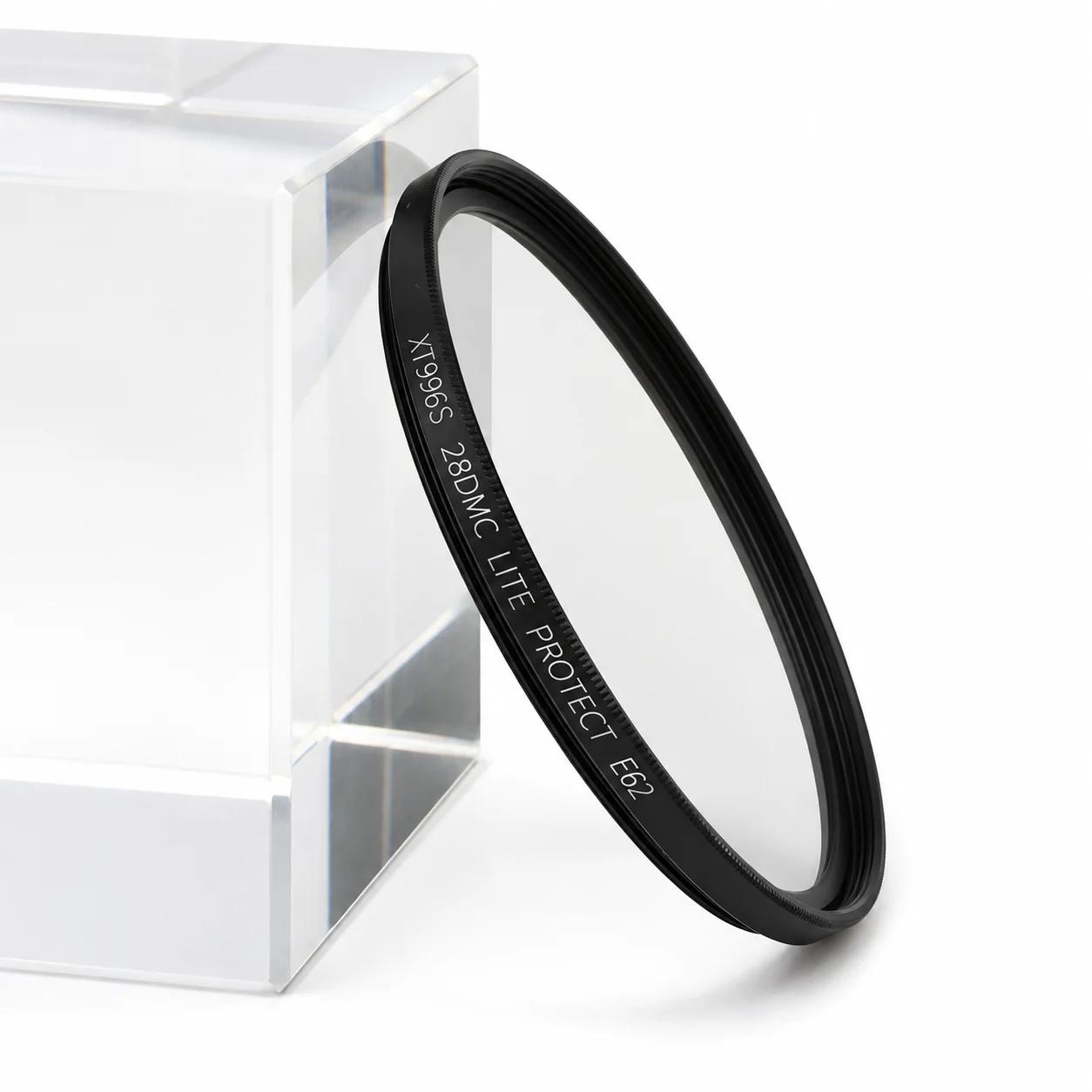
That is why the coating numbers matter more than the marketing copy. The XT996S Lens Protection Filter in 77mm is specified at an average transmission of ≈99.6% and an average reflectance of ≤0.25%, with a dual-side 28-layer multi-coating. In plain terms: it passes almost all the light and gives the stray reflections very little to bounce off, so the image behind it looks like it did before you screwed the filter on.
Neither figure means "zero flare under a direct backlight." Any extra glass boundary can reflect a bright point source if you aim straight into it. It means the filter is built so that in normal use it stays out of the way — which is exactly what you want from a protector you leave mounted.
If you want a polarizer in 77mm
The XT003 CPL is the matching 77mm polarizer: polarizing efficiency 99.8%, Nitto polarizing film, optical-grade white glass, and a dual-side 24–32 layer multi-coating. Its average transmission is ≈44%, which is normal for a CPL — a polarizer physically absorbs part of the light to do its job, so you lose roughly a stop and a half and should not read that number as a defect.
Because a polarizer works by rotating, it needs a rotating ring; keep the front free of a hood that blocks access when you are dialing the effect in and out.
If you want the opposite of glare control — a softer highlight look for street lights — the same 77mm thread takes the XT888 135 Top black mist. It is a different job for the same mount, so buy it for the look you want, not as a second protector.
One practical note on a 24mm-wide zoom: do not stack a clear filter and a CPL at once. Two filters add four glass surfaces and a fat ring at the exact focal length where a full-frame ultra-wide is most prone to vignetting. Use one at a time — protection for a normal day, the CPL when the shot calls for it.
Who should not buy anything
If the f/4L lives on a tripod in a studio, gets capped between setups, and never travels, skip the filter. Nothing is threatening the front element, and no filter improves an image it was not designed to change.
For everyone else who carries the lens in a bag, shoots near water, or lends a camera to someone occasionally, the order is simple: a 77mm clear barrier first, and a 77mm CPL later only if you actually shoot the scenes a polarizer fixes.
Check the ø marking on your barrel, confirm it reads 77, and buy one filter in that size.
Shop XT996S 77mm.
— Leo Liang