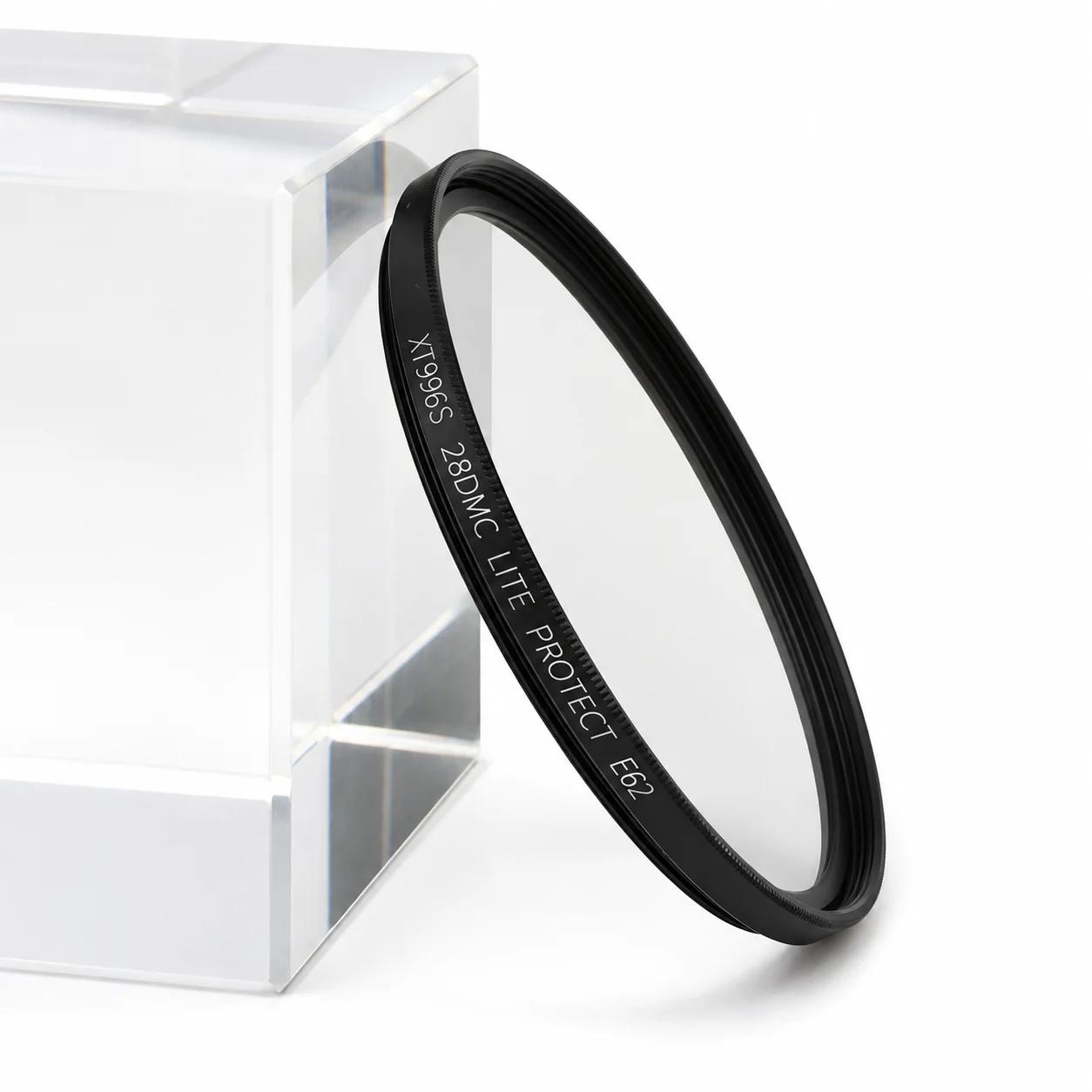
The official filter diameter for the OM System M.Zuiko Digital ED 12-40mm F2.8 PRO II is 62mm. If you have the earlier Olympus M.Zuiko 12-40mm f/2.8 PRO, the thread size is the exact same 62mm. You can confirm the official filter diameter on the OM System product page or by checking the ø62 mark on your lens barrel.
I run XT Filters. Since March 2025, the Panasonic GH7 paired with the OM System 12-40mm f/2.8 PRO II has been my main street body. On that lens, I keep our XT996S Lens Protection Filter in 62mm mounted almost all the time. With it on, I have seen no visible image-quality loss. If a friend asked what to put on their 12-40, that is the direct answer: buy 62mm, mount a solid clear barrier, and leave it on.
The 62mm thread across both 12-40 generations
When searching for the 12-40mm PRO II filter size, the badge shift from Olympus to OM System causes occasional confusion. Mechanically, nothing changed. Both versions use the identical 62mm thread with standard pitch. Caps, step rings, and 62mm filters screw onto either copy without issue.
The hood design makes filter use simple on this zoom. The lens hood mounts directly to an outer bayonet ring on the barrel, completely separate from the internal 62mm threads. A standard 62mm filter sits flush inside the nose, so you can attach, remove, or reverse the hood without binding against the filter ring.
If you ever want subtle highlight bloom for street lights later on, a 1/4 black mist filter also comes in 62mm. But for everyday carry, what this lens usually needs first is simply a neutral barrier to guard the front glass from daily handling.
Does a protection filter hurt image quality on the 12-40?
The question people usually ask after checking the OM System 12-40 filter size is whether adding glass softens pictures or cuts contrast.
Digital sensors already use an internal filter stack that blocks ultraviolet and infrared light. A screw-in UV or clear filter on a mirrorless body does not exist to fix bluish haze like it did on film. Its job is physical protection.
Optical issues only appear when glass or multi-coating is poor. The curved front element of the 12-40 PRO II is coated to control flare. Adding flat glass introduces two new air-to-glass surfaces. Without proper coating, bright lights bounce between the filter and front element, producing flare rings, ghosting, or veiling glare that lifts shadow blacks.
That is why you judge a protector by its coating specifications rather than marketing claims. For the XT996S, we use a dual-side 28-layer multi-coating that holds average transmission to ≈99.6% and keeps average reflectance to ≤0.25%. That combination means everyday protection without eating light or adding obvious flare in bright scenes.
On my own GH7 and 12-40 PRO II setup, I have seen no visible image-quality loss. I do not claim zero flare or zero ghosting under direct backlight—any extra glass boundary can create some reflection if bright lights hit it directly. But as an accessible entry-level clear barrier, the XT996S leaves your image alone.
Daily carry, evening seaside shoots, and the external zoom
My habit with the 12-40mm PRO II comes down to daily carry. The GH7 with the 12-40mm PRO II weighs roughly 1.2kg, which in a backpack makes daily street walks practical. In Hong Kong cityscape shooting, I often work handheld at 1/15s where the camera's IBIS is effective, keeping buildings sharp while pedestrians blur.
Inside a backpack, the lens rubs against the bag lining, and some days I forget the lens cap. With the XT996S mounted, I worry much less about the front element picking up grit or scuffs.
It is also part of a stable setup for evening seaside shoots, protecting the front element from salt haze and fingerprints.
One honesty note: the 12-40mm PRO II is an external-zoom lens. As you zoom from 12mm to 40mm, the barrel extends. A screw-in filter protects only the front glass. It does not seal sand or grit out of the extending barrel seams or camera body. When I shoot along the coast, I stay away from breaking waves and blowing sand. A filter guards the front element; it cannot make an external zoom sand-proof.
Who needs a 62mm clear filter
If you only shoot in a controlled studio, work on a tripod, and cap the lens between setups, skip the filter. You do not need extra glass when nothing threatens the front element.
Get a 62mm UV filter for the Olympus 12-40 or OM System II if you carry this kit out in the open—tossing it into a backpack, walking busy streets, or working seaside.
The XT996S is built as a value protection filter—not a high-end luxury piece, but a reliable physical barrier that stays out of your way optically. Check the 62mm thread on your barrel, mount one filter at a time, and let the front element do its job.
Shop XT996S 62mm.
— Leo Liang