Holiday portraits with Christmas lights often look one of two ways straight out of a modern digital camera: either the tiny LED bulbs look pin-sharp and harsh like white needles, or post-production glow filters turn the subject's face into an unrecognizable muddy haze.
A physical black mist filter solves this problem at the glass by scattering a controlled fraction of light around bright point sources while letting direct light pass cleanly through. For holiday lights and indoor portraits, screwing on a diffusion filter softens that aggressive digital edge and rolls off highlights naturally. But getting that warm, cinematic bloom without losing skin contrast comes down to filter grade, light placement, and exposure balance.
Why 1/4 density is the practical starting point
Diffusion filters usually range from 1/8 up to 1/2 or full strength. On paper, starting with a mild 1/8 seems safe. In practice with Christmas lights, 1/8 is often barely visible. Modern holiday fairy lights use small, low-wattage LEDs. Because the light source itself is tiny, an eighth-strength filter does not scatter enough photons across the surface to produce a distinct halo; you end up zooming to 200% just to check whether the filter was even attached.
On the other end of the spectrum, 1/2 strength is too heavy for close-up portraits. When string lights sit close to the subject, a half-strength mist scatters stray light across every shadow zone in the frame. Blacks lift into milky gray, contrast collapses, and eye detail turns soft.
This is why XT Filters manufactures Black Mist filters exclusively in 1/4 strength. A 1/4 grade provides enough diffusion to bloom small holiday bulbs into visible, soft halos while preserving facial structure and shadow density. You get the warmth of the lights without sacrificing the portrait.
Balancing light ratios: why the room cannot be pitch black
The most common mistake when shooting Christmas lights is turning off every room light and relying solely on the tree. A camera sensor cannot handle that contrast range. If you expose for the fairy lights, your subject is thrown into deep darkness. If you expose for the subject's skin, the lights blow out completely to pure white and the mist filter turns the entire background into a washed-out blur.
To keep the glow natural:
- Introduce a soft ambient base: Use a dimmed warm lamp bounced off a white wall or an LED panel set to 2700K–3200K dialed down to low output. You want just enough light on the subject's face so your camera can expose their eyes comfortably at ISO 400 to 1600.
- Let the string lights act as practical accents: With the face gently illuminated, the Christmas tree and fairy lights will sit roughly 1.5 to 2 stops above your ambient exposure. That is the sweet spot where the mist filter blooms the highlights without overwhelming the frame.
Distance and angle: keep the bulbs off the front element
A mist filter scatters light that enters the lens at an angle. How that halo looks depends heavily on where the lights are positioned relative to the camera:
- Background fairy lights (bokeh bloom): Position your subject two to four feet in front of the tree or string lights and shoot with a wide aperture (f/1.8 to f/2.8). The out-of-focus background discs will not only blur into soft circles, but the 1/4 mist will feather their hard circular edges into gentle, glowing spheres.
- Foreground string lights: Draping lights close to the lens is a popular seasonal technique, but keep individual bulbs at least two to three feet away from the front element. Placing a bare LED bulb right against the filter glass floods the entire coating with direct glare, creating a flat haze that wipes out contrast across the entire frame.
- Angle to the lens: If a direct bulb points straight down the barrel of the lens, expect a strong veiling flare. Turning the camera slightly so the light source sits at a slight angle allows the filter to halo the light source without flattening foreground shadows.
Choosing the right mist filter for holiday shooting
Not all diffusion filters handle stray light the same way. The optical glass and anti-reflective coatings determine how cleanly the filter controls halation when direct bulbs enter the frame:
For indoor portraits and tree lights: XT888 Top
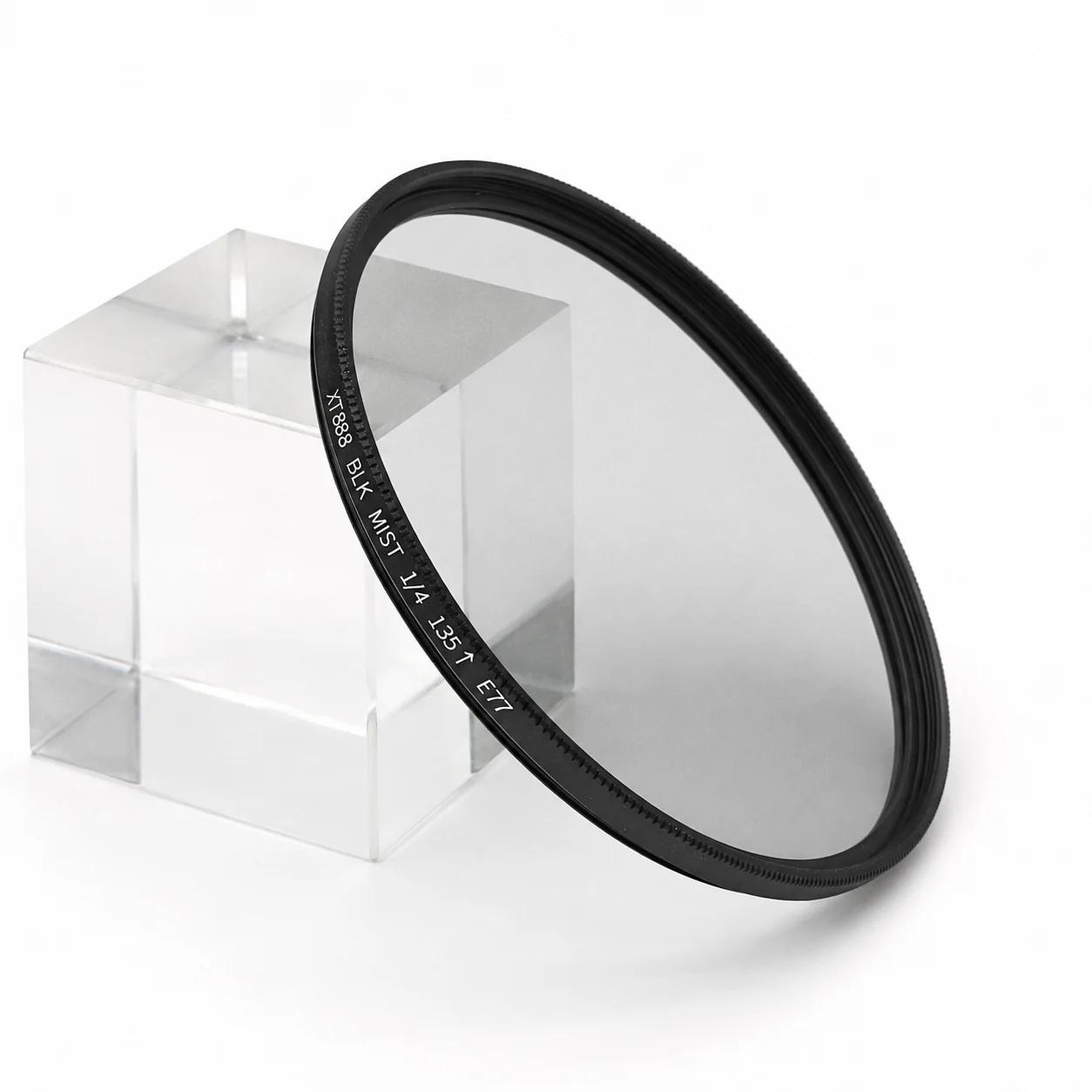
When your priority is keeping facial skin texture, eyelashes, and eyes crisp while giving holiday lights a gentle, cinematic spread, the XT888 135 Top Black Mist is specifically tuned for sharpness.
- Diffusion character: Its mist effect sits between 1/8 and 1/4, designed for portraiture where highlight diffusion must not compromise fine subject resolution.
- Coating: Double-sided 28–36 layer multi-coating.
- Optical performance: Average reflectance sits at ≈0.3%, with average light transmission of 89%–92.5%.
The controlled reflectance keeps contrast solid even when multiple string lights are scattered across the background, making it the most balanced choice for living room portraits and holiday family gatherings.
For outdoor city lights and bright commercial displays: XT925
If your holiday shoot moves outside—photographing under high-output street decorations, commercial light tunnels, or neon holiday displays—the sheer brightness of the bulbs demands maximum reflection control.
- Diffusion character: Full 1/4 density with wide highlight halation.
- Coating: Double-sided 36–48 layer multi-coating.
- Optical performance: Average reflectance is reduced to ≈0.1%, with average light transmission of ≈89%–92.5%.
That ≈0.1% reflectance is critical when shooting around high-intensity holiday displays at night. It prevents secondary ghosting between the rear filter element and your camera lens, so you get clean, organic halos around exterior lights without phantom reflections bouncing across the dark sky.
Practical camera settings for holiday lights
- White Balance: Set a fixed Kelvin temperature (3000K–3600K) or Tungsten preset rather than Auto White Balance. Auto WB will constantly shift cooler as you reframe, trying to neutralize the warm holiday glow.
- Aperture: Shoot between f/1.8 and f/2.8 for portraits where you want creamy background light discs. If you want more of the tree structure visible, f/4 maintains enough sharpness while the 1/4 mist still catches the bulbs.
- Shutter speed: Watch your shutter speed around hand movement. String lights look best when shot with natural posture, so keep your shutter at 1/125s or faster to avoid motion blur on the face.
If you are planning holiday portrait sessions this season, adding a dedicated mist filter brings that filmic warmth in-camera before you ever open an editing panel.
Check your lens thread diameter (printed on the front of the lens barrel next to the ø symbol) and explore the XT888 Top Black Mist for indoor portraits, or the ultra-low-reflection XT925 Black Mist for outdoor city displays. Order before the holidays to have your kit dialed in before the lights go up.
— Leo Liang