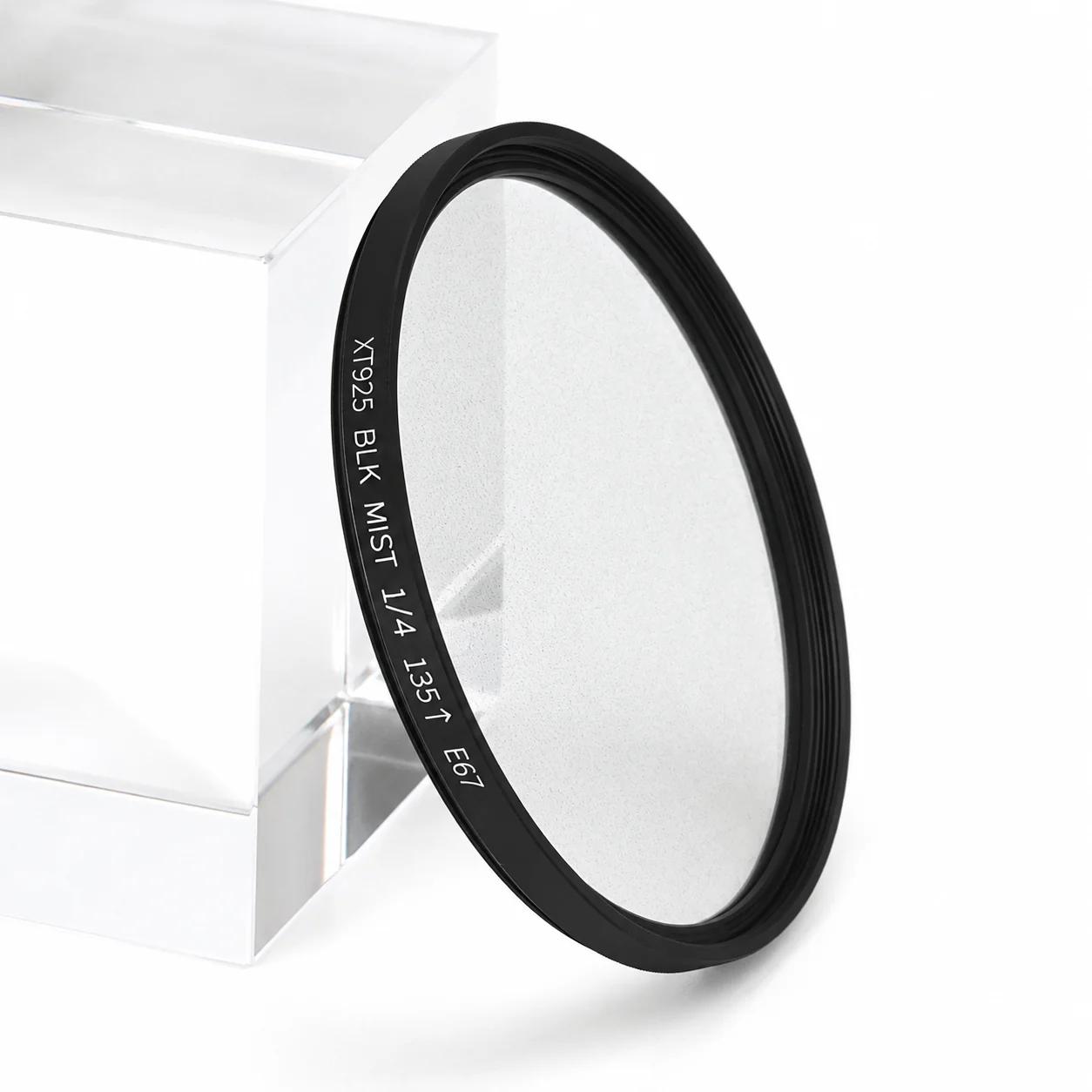
A black mist filter is not supposed to change color. It spreads a little of the light around bright sources; it does not sit there adding a tint on purpose. So when someone says their shots look warm, green, or just "off" with a mist filter on, the density is usually not the cause. The cause is what the glass and coating do to light on the way through — and because a filter adds two new air-to-glass surfaces in front of your lens, a cheap or dirty one can shift color and lift the blacks, which people often read as the same problem.
You can find out whether yours actually does, in about two minutes. Here is the test I would run on any mist filter before trusting it on skin or product color.
The two-minute test
Set a manual white balance first. This is the step everyone skips, and it is the one that decides whether the result means anything. If your camera is on auto white balance, a filter can quietly change what the camera decides "neutral" is, and you will spend an hour chasing a cast that your own camera introduced. Pick daylight, tungsten, or a fixed Kelvin value, and lock it.
Then put something neutral in frame — a gray card, a white wall, a white shirt, or a flat patch of overcast sky. More than one neutral object is better, because a cast should show up the same way on all of them.
Now shoot the same frame twice without moving the camera:
- one frame with no filter,
- one frame with the mist filter on.
Keep aperture, shutter, and ISO identical. Shoot RAW if you can; JPEG processing can hide or invent shifts.
Back at the computer, open both, and use the eyedropper on the same point in each frame. Read the R/G/B values. A real cast is a consistent gap across the whole frame — with the mist on, your neutrals read a little warm or a little green everywhere, including shadow areas. Then flip between the two images and watch the black level as well as the hue. If the mist frame looks brighter in the shadows and hazier overall, that is a weak coating bouncing light between the filter and the front element. That is not a color cast, and it is not fixable in post without losing contrast.
A cast, or something else?
Three things get called a color cast that usually are not one:
- The glow itself. The halo around a light is the entire point of a mist filter. It is diffusion, not a tint.
- Flare and ghosts. Stray light from a bare bulb or the sun off the front element changes as you move the camera. A cast does not move with your angle; flare does. If the tint only appears when you point at a light source, you are looking at reflections, not color.
- The frame. If the shift appears or disappears as you rotate the filter ring, suspect the ring reflecting at an angle, not the glass.
A genuine cast is uniform, stable, and visible on neutrals that are far away from any light source.
Why budget mist filters show up in these threads
Read enough photography forums and the recurring complaint about budget mist filters is the same pair: a slight warm or green shift, and a loss of contrast. That tracks with the construction. A mist filter needs enough density to spread highlights, and some low-cost ones reach that with fewer coating layers or simpler glass. Fewer layers means more surface reflection, and over a stack of elements that can read as haze or a faint tint. Fast, cheap coatings also vary more from copy to copy.
One more cause that is not the filter's fault: stacking. Mist filter plus UV, or mist plus polarizer, is two or three pieces of glass and four to six surfaces. Test each filter alone before blaming the mist. (And clean the glass — a fingerprint or a smear of condensation scatters light and looks like a coating problem.)
What our own numbers say — and do not say
We specify reflectance on our mist filters, because it is the number that governs stray light:
- XT925 — average reflectance ≈0.1%, double-sided 36–48 layer multi-coating.
- XT888 Top and Bottom — average reflectance ≈0.3%, double-sided 28–36 layers.
The lower figure on the XT925 is the reason it is the one we point at night work: with point lights and neon in frame, less light bounces back off the surface, so you get the halo around the lights with fewer stray reflections to clean up. That is a specification, not a promise that every camera and every light will look identical. I am not going to tell you our filters are cast-free. I cannot test every sensor and every light, and the point of the two-minute test is that you can check your own.
For reference, we make these mist filters in a 1/4 grade only. There is no 1/8.
If your test does show a shift
- Lock a custom white balance for the session with the filter on, or build a camera profile for it.
- Clean both sides of the glass and re-run the test.
- Separate flare from color: shoot the same neutral scene once facing the light and once with the light behind you.
- If a neutral patch still moves more than you can accept for skin or product color, that filter is the wrong tool for that job — it will be the same on any body.
Test any mist the same way: one scene, fixed white balance, one frame with and one without. Whatever the brand, the test tells you more than the marketing page does.
If yours points you toward a low-reflection 1/4 for night scenes, the XT925 Black Mist is the one our spec sheet puts at ≈0.1% average reflectance. Keep a cleaning cloth within reach so you are comparing coatings, not fingerprints.
— Leo Liang