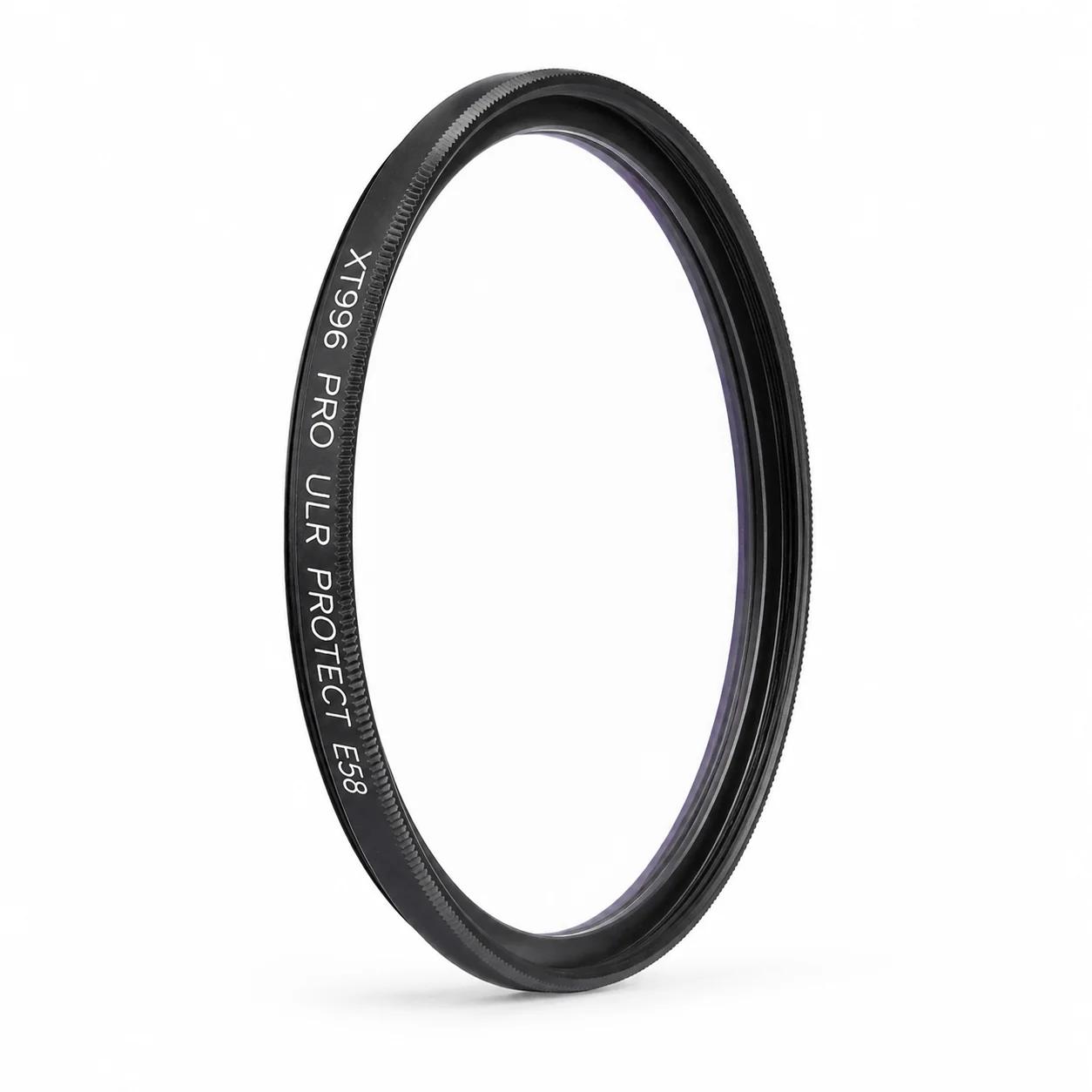
The Sony FE 24-70mm f/2.8 GM II takes an 82mm front filter. If you want a protector on it, order 82mm, put one filter on at a time, and pick the glass by how it handles reflections rather than by the word "UV" on the box.
I run XT Filters, and I haven't shot the GM II myself, so I'm not going to tell you what any filter looks like on it at 24mm. What I can do is explain where problems come from on a wide 82mm zoom, and how to check your own copy in five minutes.
Frame depth and the wide 24mm corner
At 24mm on full-frame, your diagonal angle of view spans roughly 84 degrees. With an angle that wide, filter frame profile matters. When a ring sits too deep, or when filters are stacked, the outer rim intrudes into the corners of the optical cone. That causes mechanical vignetting: harsh, dark clipped corners that software lens profiles cannot fix because image data was physically blocked.
A single filter is far less likely to cause it than two stacked ones. So the rule I'd give a friend: don't stack at 24mm. If you mount a polarizer or a mist filter, take the protector off first.
Why reflectance matters more than transmission
Most buyers look only at light transmission when shopping for protection glass. Both of our filters list an average transmission of ≈99.6%, meaning shutter speeds and exposure remain unchanged. Light passes straight through without noticeable loss.
The optical variable that actually separates filters is surface reflectance. The GM II front element is curved and multi-coated. Screwing flat glass in front introduces two flat reflective boundaries.
When bright light sits in or near the frame—night streetlights, oncoming headlights, stage spots, or an afternoon sun—higher reflectance bounces light between the filter and lens elements. That internal bounce creates ghosting, flare rings, and veiling glare that lifts shadow blacks.
The XT996S Lens Protection Filter uses a double-sided 28-layer multi-coating to keep average reflectance at ≤0.25%. It works as a solid everyday clear barrier.
The XT996 PRO Black Frame Lens Protection Filter steps up to a double-sided 36–48 layer multi-coating, lowering average reflectance to ≈0.08%. That ≈0.08% is well under the XT996S's ≤0.25%, which is what you want when the sun or city lights sit in the frame.
UV glass versus clear protection on digital sensors
Shooters often ask whether a modern mirrorless camera needs a UV filter or a clear protector.
On film, UV showed up as bluish haze in distant landscapes, and UV filters earned their place. Digital cameras put a filter stack over the sensor that already cuts most UV and infrared, so on a Sony body a screw-in UV filter does very little for haze.
In practice, a UV filter and a clear protector do the same job on a mirrorless camera. Both serve as sacrificial armor against dust, sand, salt spray, fingerprints, and direct scratches. The XT996 PRO is built as a UV protection filter with dust-, water-, and scratch-resistant properties; the XT996S is a clear protection filter. Judge both as protectors, not as haze filters.
Picking between XT996 PRO and XT996S
If you are matching an 82mm filter to the Sony 24-70 GM II, the choice comes down to lighting conditions and budget:
- XT996 PRO Black Frame (82mm): Our default recommendation for glass in this class. It costs more than the XT996S, but its double-sided 36–48 layer multi-coating delivers ≈0.08% average reflectance alongside ≈99.6% average transmission. If you shoot backlit portraits, sunsets, or night streets, this is the one.
- XT996S Clear Protection (82mm): Our lower-priced option covering 39–82mm. It offers ≈99.6% average transmission with ≤0.25% average reflectance through a double-sided 28-layer multi-coating, providing a reliable physical barrier without changing exposure or color.
The XT996S is the one I keep on my own lens, a different one: the OM System 12-40mm f/2.8 PRO II on my Panasonic GH7, since March 2025. I haven't seen any image-quality difference with it on. The lens sometimes rubs against my bag and some days I forget the cap, and with the filter there I don't worry about the front element. It also stays on for evening shoots by the sea.
On an optic as capable and costly as the GM II, the XT996 PRO in 82mm makes the most sense for difficult lighting. If you simply want a trustworthy barrier against dirt and fingers without spending extra, the XT996S does the job.
How to check your setup before a shoot
Whatever filter you choose, verify corner clearance yourself before heading out to shoot. Mount the filter alone. Set the zoom to 24mm, open wide to f/2.8, turn off in-camera shading compensation, and shoot an evenly lit white wall or overcast sky. Inspect the raw corners at 100%. If you see natural light falloff that lifts smoothly when stopped down, you are fine; if you see hard, clipped black corners, your frame or stack is intruding.
Pick 82mm.
Shop XT996 PRO 82mm.
— Leo Liang