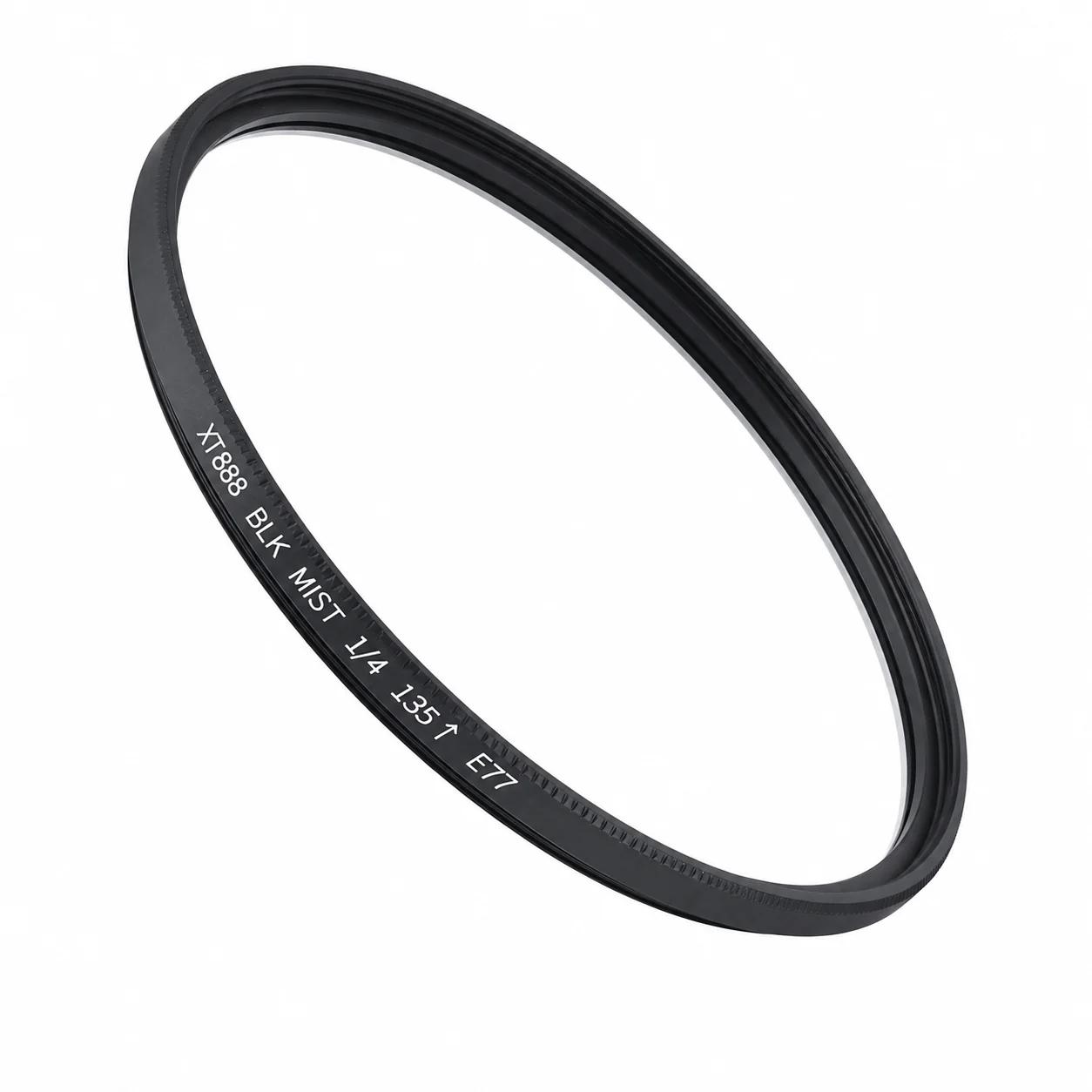
No. A black mist filter does the same thing to a single frame that it does to a clip. The sensor never knows whether the shutter is going to open again a fortieth of a second later, and the glass in front of it is not checking.
What changes is the way you look at the result. That is where the idea comes from, and it has less to do with optics than with how we watch video and how we inspect photographs.
Why people file it under video
The name did some of the damage. Pro-Mist, black diffusion, mist — the vocabulary came out of film and television work, so the filter got filed under motion long before most stills photographers had handled one.
Then there is the fact that a moving highlight is where the effect is easiest to see. Watch a light travel across a frame and the halo around it re-forms as it moves; your eye follows it and reads it as atmosphere. Freeze the same highlight and you get one soft edge, sitting still, and your eye goes hunting for a defect instead. Nobody scrubs a video frame at 100% on a 27-inch monitor, and almost everybody does that to a photograph.
The last part is post. A glow that is baked into footage is there forever, so video shooters buy glass. A stills shooter tells himself he can add the look later in Lightroom, and partly he can — but what a mist filter does to a highlight is not the same as what a glow slider does to it, as I argued in the post about what Lightroom can't fake. The belief is usually enough to keep the filter in the bag.
What the glass does to one frame
A black mist scatters a small share of the light coming from bright areas into their neighbours. The bright core spreads and softens, the dark stays dark, and the whole frame loses a little of that hard digital edge where a highlight meets a midtone. It is a mechanical, per-frame operation.
Two specs tell you what it will cost you. The XT888 Bottom 1/4 is rated at an average reflectance of ≈0.3% and an average transmission of ≈88.8%, with a double-sided 28–36 layer multi-coating. Reflectance is what comes back off the glass and lands as haze or a ghost spot, so lower is better when a light sits just outside the frame at night. Transmission is the light you actually keep, and 88.8% means you are handing back more than a tenth of it.
That sounds worse than it is, and it matters more than the marketing suggests. At noon at f/8 you will not notice. In a dim room at f/2.8 you are already riding the ISO, and a filter that costs you about a sixth of a stop is not free — it is just cheap enough that most people never notice it.
Where it shows on a still
Direct sun on a face is the clearest case. The white edge along a cheekbone or a forehead normally clips into a flat, hard-edged disc. At 1/4 the edge rolls off instead, and the skin underneath keeps its texture: pores, lashes, the fine line at the corner of an eye. That is the whole argument for 1/4 rather than something heavier — you get the roll-off and you keep the detail that makes the frame a photograph rather than a filter demo.
Night is the other one. Street lamps, shop signs, headlights — the core holds its colour and the edge spills, which is exactly what your eye does when it looks at a light in the dark. This is where reflectance earns its keep, and it is also where a cheap uncoated mist gives itself away, because the veil over the blacks grows with every light in the frame.
What it will not do is rescue a blown sky, sharpen a soft lens, or hide a bad exposure. And where the frame is mostly detail — architecture, lettering, packing shots, anything a customer is going to zoom into — the mist is a cost with no return. I shoot a lot of architecture in Hong Kong, and that is the work where I would take it off first. If that is your week, this post on when to unscrew it is the more useful read.
Under 135mm, and above it
Focal length changes how dense the diffusion looks, because a longer lens magnifies it along with everything else. Our two 1/4 mist filters split on that line.
The XT888 Bottom 1/4 is tuned for lenses under 135mm, 39mm to 105mm, and it is the one for the glass that stays on the camera — the 28, 35, 43 and 50mm you carry all day. The XT925 is for 135mm and up: same 1/4 strength, an average reflectance of ≈0.1%, a double-sided 36–48 layer coating, and threads from 39mm to 112mm. If you are out after dark with a long lens and lights in the frame, that lower reflectance is the reason to pick it.
Pick the strength once, pick the filter by the front of your lens, and stop thinking about it. Read the ø number on the barrel and order that size.
Our own side-by-side set — clean frame, Bottom 1/4, Top, same face in the same light — is still on the shot list, so this post has no frames in it. I would rather write down what the glass does than dress up a comparison I have not shot. When those frames exist, I will show them.
— Leo Liang