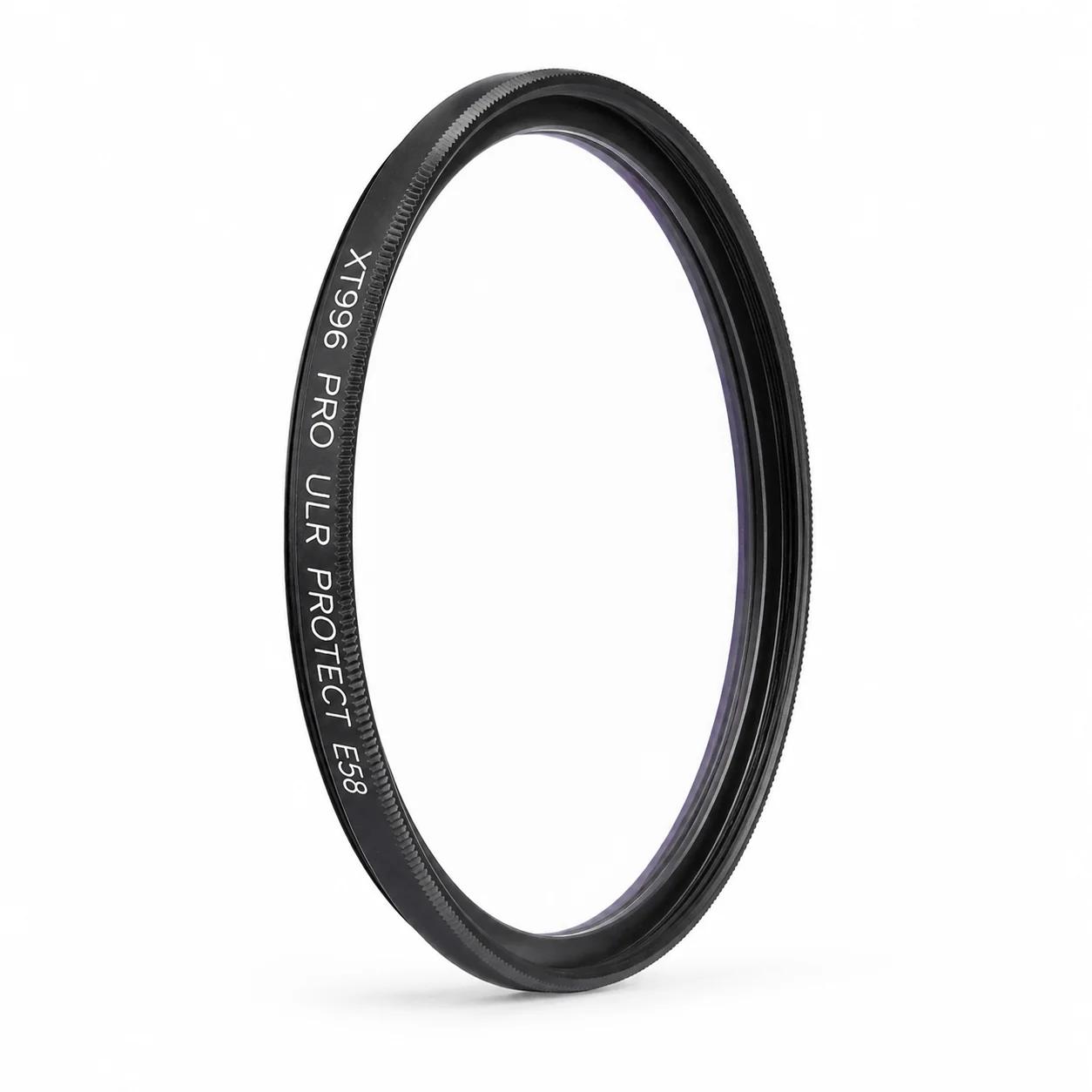
If you screw a twelve-dollar unbranded UV filter onto a two-thousand-dollar lens, will it ruin your photos?
Yes, but almost never for the reason people think.
Photographers worry a cheap filter will soften fine detail or blur their sharpness. In flat, overcast daylight, you can shoot through a cheap piece of glass and the center of your frame will usually look fine on an Instagram preview. Where a bad filter ruins your shots is contrast, flare, and ghosting. Under harsh sunlight, backlit street scenes, or night lamps, cheap glass behaves like a partial mirror. It bounces light straight back into the front element of your lens, washing out shadow contrast and scattering ghost artifacts across your sensor.
When shooters decide to upgrade to reputable names like B+W, Hoya, or our own glass, they usually get hit with a wall of marketing terms—"nano-matrix," "military-grade armor," "HD optical purity." You can ignore all of that. When comparing filters, you only need to check four concrete numbers on the manufacturer spec sheet.
Here is how to read those numbers, what they actually mean in the field, and how to tell whether a filter is genuine optical glass or overpriced window pane.
What Does a UV Filter Actually Do? (Wavelengths and Cutoffs)
To understand UV filter specs, you first have to separate film cameras from modern digital sensors.
Traditional black-and-white and color film emulsions were chemically sensitive to ultraviolet radiation (roughly 300nm to 400nm wavelengths). At high altitudes or over open water, scattered UV light caused bluish color casts and washed-out distant haze. Screwing a glass filter that blocked ultraviolet wavelengths made a visible difference on film.
Modern digital CMOS and CCD sensors already have an internal UV and infrared cut filter bonded directly over the silicon cover glass. Your camera sensor does not see UV light. On digital cameras, a UV filter functions primarily as a clear mechanical shield to protect your front lens element from flying gravel, sand, saltwater spray, and sticky fingerprints.
However, UV filters are still engineered around specific light cutoff wavelengths, usually designated by "L" numbers:
- L37 Filters: Cut ultraviolet light below 370 nanometres.
- L39 Filters: Cut light below 390 nanometres, stopping UV right at the boundary where invisible ultraviolet meets visible violet light (~400nm).
On a spec sheet, look for the cutoff wavelength. For example, our XT995 PRO L39 Black UV Filter specifies a 390nm cutoff wavelength. That sharp cutoff ensures the glass absorbs stray ultraviolet scatter without cutting into visible blue light or altering your color balance.
If a filter is labeled "UV" but gives no cutoff wavelength anywhere in its technical specs, it is usually plain untinted glass sold under a legacy name.
Spec 1: Average Reflectance (The Real Ghosting Culprit)
If you only check one specification before buying a protective filter, make it average reflectance.
Every time light passes through a boundary between air and uncoated glass, roughly 4% of that light reflects off the front surface and another 4% reflects off the back surface. That means about 8% of all light entering your lens bounces back and forth between the filter and the curved front glass elements of your lens.
When light reflects internally, two things happen:
- Veiling glare: Stray scattered light washes across the frame, turning deep blacks into muddy gray shadows.
- Ghosting: Bright light sources—like the sun, stadium floods, or oncoming headlights—reflect off the sensor and the rear of the filter, creating green or magenta ghost spots directly opposite the light source.
Anti-reflective multi-coatings work by depositing microscopic layers of metal oxides onto the glass. Each layer is engineered to a specific microscopic thickness so reflected light waves interfere destructively and cancel each other out.
When reading reflectance numbers:
- Uncoated or single-coated glass: Reflectance of 1.5% to 4.0%. Severe ghosting in any backlit scene.
- Standard multi-coated glass: Reflectance around 0.2% to 0.5%. Acceptable for general daylight, but prone to ring flare around direct streetlights.
- High-end professional glass: Reflectance below 0.15%. Minimal internal reflection even under intense contrast.
Compare published table values directly:
- Our standard everyday XT996S Lens Protection Filter specifies an average reflectance of ≤0.25%.
- The XT995 PRO L39 measures an average reflectance of ≈0.12%–0.15%.
- Our flagship XT996 PRO Black Frame Lens Protection Filter achieves an ultra-low average reflectance of ≈0.08%.
If a brand touts "crystal clear multi-coating" but does not publish a measured average reflectance percentage on its product page, you are gambling with flare.
Spec 2: Light Transmission Rate
Light transmission is the companion number to reflectance: how much available visible light actually makes it through the filter to your lens.
Clear protective glass should let virtually 100% of visible light pass through completely unhindered, without costing you exposure stops or shifting color temperature.
- Cheap budget filters: Often transmit 92% to 95% of light. Losing 5% to 8% of light is roughly equivalent to a tenth or a quarter stop of exposure penalty, and uneven transmission across the spectrum can introduce a subtle yellow or green tint.
- Quality optical multi-coating: Consistently transmits 99.5% or higher.
On our spec sheets, the XT995 PRO L39 specifies an average light transmission of ≈99.5%, while both the XT996S and XT996 PRO deliver ≈99.6%. At 99.6% transmission, your camera meter behaves exactly as if the filter were not there, and your sensor receives the full dynamic range your lens was built to deliver.
Spec 3: Coating Layers (Front and Back)
When manufacturers say "multi-coated," ask how many layers, and on which sides.
Single-coated filters usually have one thin layer on the front surface only. The rear surface facing your front lens element remains bare glass, leaving internal reflections completely uncontrolled.
A high-performance optical filter must have double-sided multi-coating, meaning both the front and rear glass surfaces receive precision vacuum deposition.
- Entry multi-coating: 8 to 16 total layers.
- Everyday protective multi-coating: The XT996S features double-sided 28-layer multi-coating.
- Flagship optical multi-coating: The XT995 PRO L39 and XT996 PRO both feature double-sided 36–48 layer multi-coating.
The final exterior coating layer also matters for maintenance. Premium filters add a top hydrophobic and oleophobic coat. This slick top layer prevents water droplets from beading into flat puddles and stops finger oils from sticking to the glass. In the field, you can wipe sea mist or rain off with a clean microfiber cloth in one swipe, rather than smearing grease across the lens.
Spec 4: Glass Substrate (Optical Glass vs Float Glass)
The best coating in the world cannot fix warped glass.
Cheap filters are often punched from generic float sheet glass—the same glass used for picture frames or tabletops. Float glass cools with microscopic surface waves and internal stresses. When light passes through non-parallel surfaces at wide apertures or long focal lengths, those micro-irregularities bend light rays unevenly, softening high-frequency details.
Look for precision optical glass on the spec sheet. For example, our XT995 PRO L39 specifies B270 optical glass (Schott optical crown glass). Optical-grade substrates are ground and polished under tight optical parallelism tolerances, ensuring the glass does not alter your lens optical formula or degrade edge-to-edge resolution.
If the spec sheet simply lists "tempered glass" without specifying an optical grade or parallelism standard, it is likely industrial protective glass rather than precision photographic optics.
UV Filter vs Clear Protection: Which Do You Actually Need?
Once you know how to read the numbers, the choice between a UV filter and a dedicated clear protector is straightforward:
Choose a Clear Protection Filter (like the XT996S or XT996 PRO): If you shoot digital cameras (Sony, Canon, Nikon, Fujifilm, Panasonic) and want full-time physical protection against drops, scrapes, and grime. A pure protector skips UV chemical tinting entirely, focusing all optical engineering on maximum light transmission (≈99.6%) and the lowest possible reflectance (≈0.08% on the XT996 PRO).
Choose an L39 UV Cut Filter (like the XT995 PRO L39): If you shoot film cameras, use vintage manual-focus lenses that lack modern anti-UV coatings, or regularly photograph high-altitude mountain landscapes where atmospheric UV scatter creates real haze.
In my own everyday shooting with my Panasonic GH7 and OM System 12-40mm f/2.8 PRO II, I keep an everyday protective filter mounted full-time. I walk Hong Kong streets with the camera in a backpack and wrapped in a cloth, and having dependable glass out front means I do not have to baby the lens when taking it in and out of the bag or worry if I forget the lens cap for a few blocks. When I shoot near the water around the Hong Kong Palace Museum, I stay back from breaking sea spray—the filter keeps salt off the front element, but it will not stop salt air from entering an external zoom barrel.
Quick Spec Comparison
| Specification | Cheap Budget Filter | Everyday Quality (XT996S) | Flagship Grade (XT996 PRO) |
|---|---|---|---|
| Average Reflectance | > 1.5% | ≤0.25% | ≈0.08% |
| Average Transmission | 92%–96% | ≈99.6% | ≈99.6% |
| Coating Construction | Single or None | Double-sided 28-layer | Double-sided 36–48 layer |
| Glass Substrate | Standard float glass | Optical glass | Precision optical glass |
| Ghosting & Flare Control | Noticeable veiling flare | Controlled for daily use | Extreme flare suppression |
Before you spend $100 or more on a legacy brand name—or settle for an anonymous $10 filter on Amazon—look at the published spec sheet.
Compare the numbers yourself on our XT996 PRO Black Frame Lens Protection Filter. If you need help finding the exact filter thread size for your lens, check the printed ø mark on your lens barrel or look up your model in our lens filter finder.
— Leo Liang