If you just picked up a Fujifilm X-T5, the first thing to know about buying filters is simple: camera bodies do not have filter threads. Lenses do.
Because the X-T5 is an interchangeable lens body, there is no single "Fujifilm X-T5 filter size." A compact prime like the XF 27mm f/2.8 takes a tiny 39mm screw-in ring, the popular XF 18-55mm f/2.8-4 kit zoom takes a 58mm thread, and the red-badge XF 16-55mm f/2.8 zoom requires a substantial 77mm filter.
If you are looking to protect your glass or add a mist filter to tame the high-resolution 40.2MP X-Trans sensor, here is the complete breakdown of filter sizes across common Fujifilm X-mount lenses, along with how to choose the right diffusion filter to start with.
Fujifilm X-Mount Lens Filter Size Chart
Before ordering, match your specific lens to its front thread diameter:
| Thread Size | Popular Fujifilm X-Mount Lenses |
|---|---|
| 39mm | XF 27mm f/2.8 R WR (Pancake), XF 60mm f/2.4 R Macro |
| 43mm | XF 23mm f/2 R WR, XF 35mm f/2 R WR, XC 35mm f/2 |
| 46mm | XF 50mm f/2 R WR |
| 49mm | XF 16mm f/2.8 R WR |
| 52mm | XF 35mm f/1.4 R, XF 18mm f/2 R, XC 15-45mm f/3.5-5.6 OIS PZ |
| 58mm | XF 18-55mm f/2.8-4 R LM OIS, XF 16-50mm f/2.8-4.8 R LM WR, XF 23mm f/1.4 R LM WR, XF 33mm f/1.4 R LM WR |
| 62mm | XF 18mm f/1.4 R LM WR, XF 56mm f/1.2 R (Original), XF 55-200mm f/3.5-4.8 R LM OIS |
| 67mm | XF 56mm f/1.2 R WR (New), XF 70-300mm f/4-5.6 R LM OIS WR, XF 16mm f/1.4 R WR |
| 72mm | XF 10-24mm f/4 R OIS WR, XF 16-80mm f/4 R OIS WR, XF 50-140mm f/2.8 R LM OIS WR |
| 77mm | XF 16-55mm f/2.8 R LM WR (Mk I), XF 100-400mm f/4.5-5.6 R LM OIS WR |
(If you are shooting a third-party lens from Sigma, Tamron, or Viltrox, you can verify your exact thread in seconds using the XT Filters Lens Filter Finder.)
Watch out for the 39mm pancake trap
Many photographers moving from a fixed-lens Fuji camera like the X100VI assume compact Fujinon lenses use 49mm filter threads. The pancake XF 27mm f/2.8 R WR actually uses an uncommon 39mm thread. Mounting generic filters on the 27mm can easily cause mechanical binding if the threads are not cut cleanly. For that lens, make sure you order a dedicated 39mm filter engineered for compact Fuji glass, such as the XT996 PRO 39mm Fuji.
How to verify the diameter on your lens right now
If you are not certain which lens is currently mounted on your X-T5, do not guess:
- Check the front rim: Look directly at the text stamped around the front glass element. Look for the Greek letter phi followed by a number—such as Ø58 or Ø67. That number is your filter diameter in millimeters.
- Check the bottom of the lens barrel: Many newer Fujinon lenses engrave the diameter on the underside of the outer barrel near the mount or focus ring.
- Inspect the inside of your lens cap: Pop off the front pinch cap and look at the reverse side. Most original Fujifilm lens caps have the millimeter diameter molded into the interior plastic.
Why X-T5 shooters gravitate toward Black Mist
Fujifilm’s 40.2-megapixel X-Trans CMOS 5 HR sensor resolves an immense amount of micro-contrast. Paired with modern linear-motor primes (like the XF 23mm f/1.4 or XF 33mm f/1.4), the raw output can sometimes look clinical and aggressive, particularly when shooting portraits, night cityscapes, or street scenes under harsh artificial light.
This is why diffusion filters have become almost standard accessories for X-T5 setups. A black mist filter does three specific optical jobs:
- Softens harsh highlight rolloff: It catches pinpoint light sources—practical light bulbs, neon signs, direct sunlight through windows—and blooms them into a gentle, organic halo.
- Lowers digital edge contrast without destroying sharpness: Unlike Gaussian blur or clarity sliders in post-production, black mist softens microscopic harsh edges while preserving the underlying optical detail in eyes, hair, and architecture.
- Subtly lifts deep shadows: By diffusing a fraction of ambient light into nearby dark tones, it smooths out the severe shadow cutoff common in modern digital sensors.
When combined with Fujifilm film simulations like Classic Chrome, Classic Negative, or Nostalgic Neg, black mist produces a textured, cinematic character straight out of camera that saves hours of color grading.
Which mist strength should you start with?
Mist filters are traditionally designated in fractions: 1/8, 1/4, and 1/2.
If you are buying your first mist filter for the X-T5, 1/4 strength is the practical benchmark.
Here is why:
- 1/8 strength is so subtle that in daylight or overcast street shooting, it is often barely noticeable. Many photographers buy 1/8 expecting atmospheric glow, only to find the effect vanishes once they step outside high-contrast night scenes.
- 1/2 strength scatters significant light across the entire frame. While useful for specialized dream sequences, it easily washes out midtone contrast and creates an overcooked "hazy lens" look for everyday walking around.
- 1/4 strength strikes the right balance. During daylight street sessions, it gently takes the digital bite off high-contrast edges without clouding the frame. At night, streetlights and neon signs generate a defined, warm bloom while keeping black levels controlled.
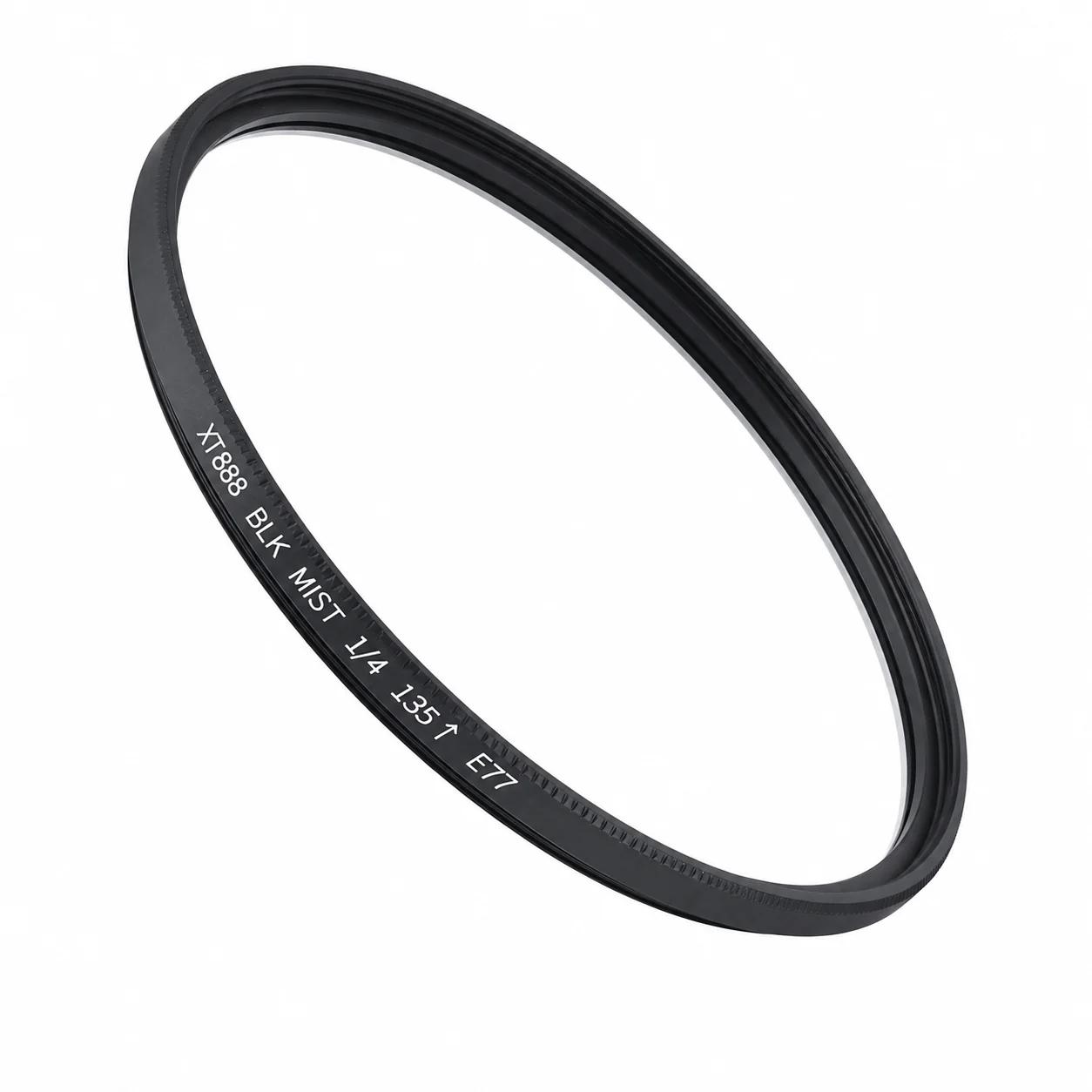
We specifically engineered the XT888 BLK MIST 135 Bottom 1/4 for this balance. Built with double-sided 28–36 layer multi-coating, it maintains ≈88.8% average light transmission and suppresses surface reflections down to ≈0.3%. It is optimized for focal lengths up to 135mm, giving you atmospheric highlight roll-off without turning your 40MP files into muddy soup.
Should you buy dedicated filter sizes or use a step-up ring?
If you own three or four lenses with different diameters (for example, a 43mm prime, a 58mm zoom, and a 72mm telephoto), you face a common dilemma: buy one large 72mm filter with brass step-up rings, or buy dedicated sizes for each lens?
Here is the honest trade-off:
- When to use step-up rings: If you shoot exclusively from a tripod, landscape vantage points, or studio environments where quick handling does not matter, buying one 72mm or 77mm filter and stepping down saves money.
- When to buy dedicated sizes: The X-T5 is designed around tactile, compact shooting. If you bought an X-T5 for travel, street photography, or documentary work, stacking a massive 77mm ring and step-up adapter onto a tiny XF 35mm f/2 or XF 27mm f/2.8 ruins the balance of the camera, prevents you from using the original lens hood, and makes pocketing the setup impossible.
For the one or two focal lengths you keep mounted 80% of the time, buy the exact filter diameter that fits the lens barrel. You keep the slim profile, retain full lens hood functionality, and keep the camera ready to shoot the moment you pull it from your bag.
Check the markings on your most-used lens, confirm your thread diameter in the table above, and select the matching size. Orders over $99 ship free worldwide.
— Leo Liang